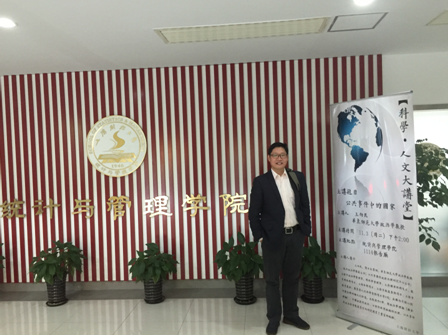
On the afternoon of November 3, 2015, Professor Wang Xiangmin from the Department of Political Science at East China Normal University was invited to the School of Statistics and Management to deliver a themed lecture on "The State in Public Events" for students at Shanghai University of Finance and Economics. This lecture was hosted by Deputy Secretary Wang Ti of the Party General Branch of the School of Statistics and Management and attracted over 120 faculty and students to attend.
Professor Wang succinctly introduced the main thread of this lecture, elucidating the origins and concepts, analyzing the political science turn in the study of social movements in the West, and discussing issues related to the political science of public event research in China, ultimately concluding that the state exhibits a pluralistic orientation in the analysis of Chinese politics.
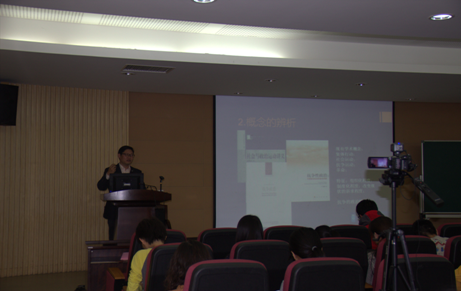
When discussing the origins and issues, Professor Wang compared the differences between the era of political science in China and the West, concluding that the phenomenon of "similar form but different essence" in both China and the West has theoretical and historical implications. He elaborated that China has entered a transitional period in institutional construction, which should be advanced little by little through negotiation games and bargaining, manifested as a series of public events. With the changes in public events in China, the term for public events has evolved from the initial "mass disturbances" to "collective incidents," but this concept has faced numerous challenges in recent years. In contrast to the political shift in Western social movement studies, Western political science has also transitioned from early foundational works in social psychology like "The Crowd" to the theory of cyclical responses and finally to Gurr’s relative deprivation theory. After discussing resource mobilization theory, political process theory, and political opportunity structure theory, Professor Wang concluded that the process of paradigm shift in social movement research—from social psychology to resource mobilization and political process analysis, and then to political opportunity structure analysis—reflects a shift from sociology to political science.
Returning to China
The political interest in the study of public events in China
Revisiting the state within the national school and its analytical dimensions, Professor Wang draws the conclusion: based on vivid real-world experiences, the state can be refined into political parties and the state, and its political structure has never faded from the perspective of public event research; rather, this is its main research viewpoint. Meanwhile, there is a strong sociological trace, with theoretical efforts but lacking a sense of history.
Finally, Professor Zhang interpreted the multiple dimensions of the state in China's political analysis, arguing that the Sino-Western phenomena are "similar in form but different in essence." The similarity lies in the "depoliticization" of Western academic resources reflected in China, while the difference stems from the anxieties and real dilemmas of nation-building in China since modern times. In short, regardless of the circumstances, the political science turn in the study of public events in both China and the West, and the return to the state, seem to suggest a spiral cycle in political analysis, or perhaps declare that the construction of the nation-state remains a future endeavor.
In the information age, students need to understand the development of public events and the differences between the East and the West, in order to learn how to approach such issues. This lecture involves humanistic knowledge and national political changes, which has a positive effect on broadening students' knowledge, improving overall quality, enriching campus cultural life, and encouraging academic research. Students learn in a relaxed atmosphere and gain a lot.