
Recently, Professor Zhang Liwen from the School of Statistics and Data Science at Shanghai University of Finance and Economics, along with his leading financial large language model research group (SUFE-AIFLM-Lab), officially released the first DeepSeek-R1 type reasoning artificial intelligence financial model: Fin-R1. This model exhibits outstanding performance with a lightweight parameter scale of only 7B, significantly surpassing other models of the same scale evaluated, ranking second with an average score of 75.2. The difference in average score with the industry benchmark DeepSeek-R1, which has a parameter size of 671B, is just 3.0 points. Fin-R1 is developed based on the Qwen2.5-7B-Instruct model. By constructing a high-quality financial reasoning dataset and employing a two-stage mixed framework for training, it achieves a logical closed loop in financial reasoning. This technological innovation indicates that universities have closed the loop from technological breakthroughs to industrial application in the development of large models in vertical fields, marking a new height in autonomous innovation by universities in the field of financial technology.
Github address: https://github.com/SUFE-AIFLM-Lab/Fin-R1
Technical Report: https://arxiv.org/abs/2503.16252
Model Address: https://huggingface.co/SUFE-AIFLM-Lab/Fin-R1
1. Introduction
Current inference-type large language models are rapidly developing in many areas; however, when general inference models are applied to the financial sector, they still face the challenge of insufficient adaptability to vertical scenarios. Financial reasoning tasks often involve knowledge of legal provisions, economic indicators, mathematical modeling, and require not only interdisciplinary knowledge integration but also verifiable, step-by-step decision-making logic. In actual financial business scenarios, model applications generally face challenges such as difficulties in knowledge integration, lack of transparency in decision-making processes, and insufficient generalization ability in operations.
To this end, we distilled and selected approximately 60k high-quality COT datasets for financial professional scenarios from multiple authoritative data sources to create the Fin-R1-Data dataset. This dataset covers multidimensional professional knowledge in the Chinese and English financial vertical fields and is divided into four major modules based on specific task content: financial coding, financial professional knowledge, non-reasoning business knowledge in finance, and reasoning business knowledge in finance. It can effectively support multiple core financial business scenarios, including banking, securities, and trusts. Based on the Fin-R1-Data, we performed instruction fine-tuning (SFT) preheating and reinforcement learning (RL) training on the Qwen2.5-7B-Instruct base model to obtain the financial reasoning large model Fin-R1. By constructing a high-quality CoT dataset in finance and combining instruction fine-tuning (SFT) and reinforcement learning (RL) in a two-stage work framework, we provide a solid theoretical foundation, decision logic, and technical implementation capability for the model's application in the financial field. This also effectively enhances the model's complex financial reasoning ability and generalization capability, allowing it to demonstrate outstanding performance in financial reasoning tasks.
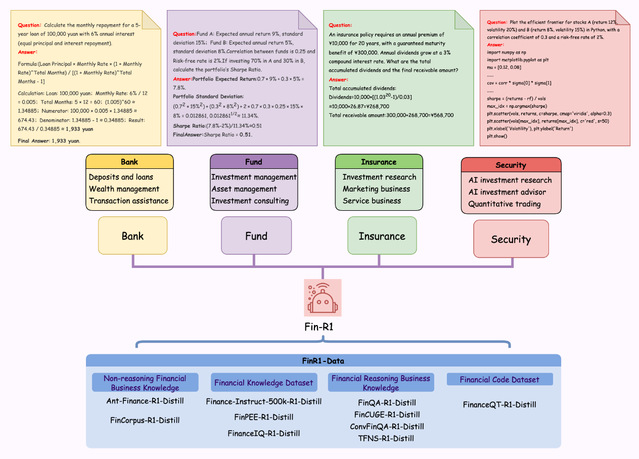
Figure 1 Example of Fin-R1 application scenarios
The overall workflow of Fin-R1 is as follows: We first build a financial reasoning dataset, Fin-R1-Data, with a scale of 60k to help the model reconstruct its knowledge system. Then, we use a "two-step training framework" to shape the model's cognition and reasoning abilities. Finally, we validate the model's performance breakthroughs on multiple financial benchmark tests, achieving a complete technical closed loop from “data construction - model training - performance validation - model deployment - scenario application.”
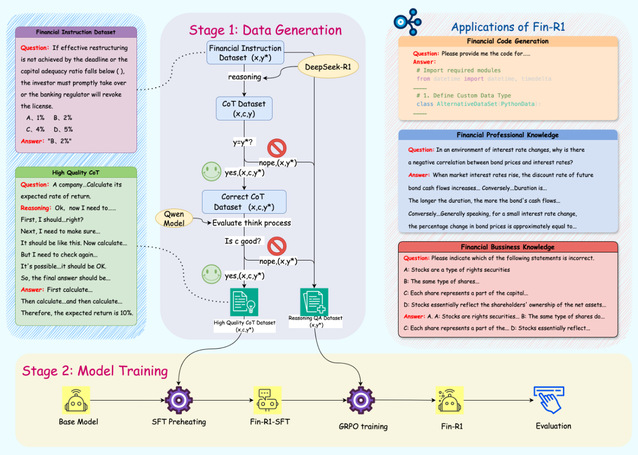
Figure 2 Overall Workflow of Fin-R1
2. Scene Application - Powerful Multi-Scene Adaptability
Financial Code:

Financial Calculation:

English Financial Calculation:

Financial security:

Intelligent Risk Control:

ESG Analysis:

3. Data Construction - Solving the Problem of Knowledge Fragmentation
Traditional financial data is scattered, has high labeling costs, and lacks targeted design for complex reasoning logic, making it difficult for models to adapt to financial business scenarios. To transfer DeepSeek-R1's reasoning capabilities to financial contexts and address the issue of high-quality financial reasoning data, we utilized Deepseek-R1 (full version) to perform domain knowledge distillation and selection on multiple datasets covering industry corpora (FinCorpus, Ant_Finance), professional cognition (FinPEE), business knowledge (FinCUGE, FinanceIQ, Finance-Instruct-500K), table parsing (FinQA), market insights (TFNS), multi-turn interactions (ConvFinQA), and quantitative investment (FinanceQT), constructing a high-quality COT dataset Fin-R1-Data with approximately 60k entries aimed at professional financial reasoning scenarios.
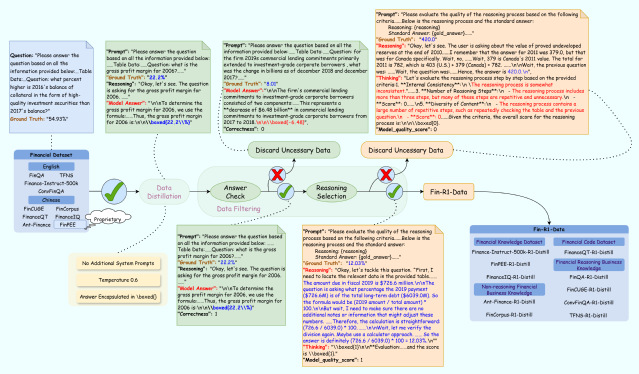
Figure 3 Fin-R1 Data Generation Process
3.1 Data Distillation
During the distillation process, we built a data distillation framework based on Deepseek - R1. In the distillation process, we strictly followed the official specifications for configuring parameters in DeepSeek - R1, with the specific parameter configuration as follows:
Set the temperature to 0.6;
For mathematical type data, use "Please wrap the final answer in \\boxed{{}}" as the standardized prompt.
l To prevent jumping out of the thinking mode, forcibly add "\n" at the beginning of each output before starting to generate data.
3.2 Data Filtering
In order to ensure data quality, the project team has pioneered a dual scoring mechanism of "Answer + Reasoning Logic," implementing a two-round quality inspection to maintain strict control over data quality.
First Round: Use rule matching and Qwen2.5-72B-Instruct to score answer accuracy, ensuring "zero errors" in the data;
Second Round: Conduct in-depth verification of the consistency of reasoning logic and compliance with terminology, ensuring that the AI's "chain of thought" is seamlessly aligned.
Round 3: Introduce a team of financial experts to manually review key data, ensuring high quality of training data.
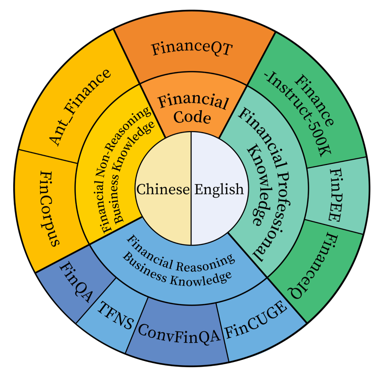
Figure 4 Fin-R1 Data Distribution
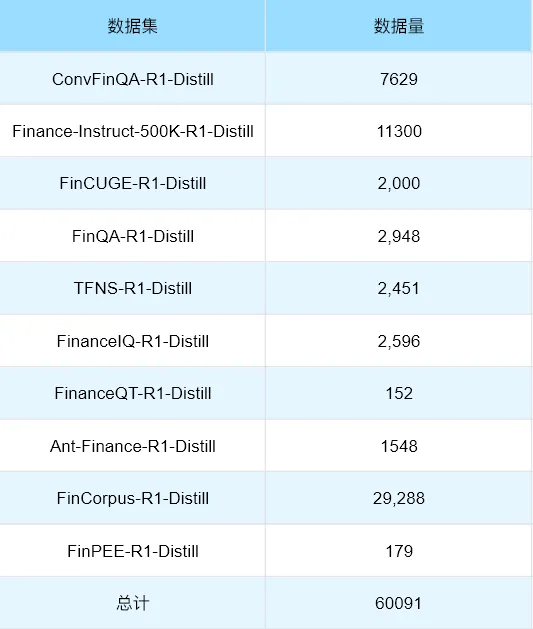
Table 1 Fin-R1 Data Volume Table
4. Model Training - The "Highlight - Exam - Scoring" Model Provides AI with "Financial Training Courses," Building Financial Decision-Making Experts in Two Steps
4.1 Special Training Results: The "Strongest Brain" in the Financial World
For complex reasoning tasks in the financial sector, we utilized Qwen2.5-7B-Instruct for two-step fine-tuning training to develop the financial reasoning large language model Fin-R1. First, high-quality financial reasoning data was used for SFT (Supervised Fine-Tuning) to help the model reconstruct its knowledge system. Then, based on the GRPO (Group Relative Policy Optimization) algorithm, a combination of format rewards and accuracy rewards was employed for reinforcement learning to enhance the accuracy and generalization ability of financial reasoning tasks. Fin-R1 can completely present the thought process, providing deep and valuable insights for financial decision-making, and establishing a reliable technical foundation for financial business areas such as financial investment, risk management, intelligent consultation, and quantitative trading. In the future, this "financial boot camp" model is expected to be replicated and promoted in more professional fields.
4.2 Fine-tuning Training (SFT Instruction Fine-tuning)
To address the issues of training instability in non-reasoning models during RL training, the research team provides targeted knowledge remediation for the AI, training the model like teaching a student, enabling non-reasoning models to grasp the fundamentals of financial reasoning. The model is subjected to directed training (SFT) using a financial reasoning dataset, equipping it with a preliminary long-chain thinking mode, reducing the training difficulty, and ensuring training stability.
4.3 Practical Optimization (RL Reinforcement Learning)
Through exams and expert scoring (RL reinforcement learning), continuously correct the AI's judgment errors in complex scenarios to ensure that each decision can withstand scrutiny. After the model masters the basic knowledge, continuously improve its professionalism through the "exam + expert scoring" mechanism (RL):
Smart examiner scrutiny: Introducing Qwen2.5-Max as a validator to check the correctness of answers, achieving higher accuracy than traditional regular expression methods.
Dual-Track Scoring System: Utilizes two types of rewards to train models: "rule-based format rewards" and "model validation accuracy rewards," achieving "both form and spirit" in financial text generation.
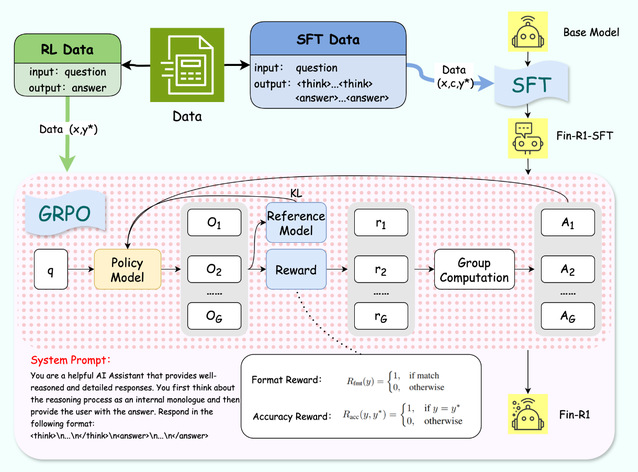
Figure 5 Fin-R1 Model Training Process
5. Performance Verification - Professional scene performance surpassing, validating the value of the technology closed loop.
In an authoritative evaluation covering multiple financial business scenarios, we considered the model's reasoning ability and resource consumption, conducting a comprehensive assessment of Fin-R1 against various models that encompass both lightweight and high-performance designs. Ultimately, Fin-R1 demonstrated significant performance advantages with a lightweight parameter scale of only 7B, achieving an average score of 75.2, ranking second overall and surpassing all other models of the same scale. It also exhibited a mere 3.0 point difference compared to the industry benchmark DeepSeek-R1, and outperformed DeepSeek-R1-Distill-Llama-70B (69.2) by 6.0 points. Furthermore, Fin-R1 topped the evaluation for two key tasks, FinQA, which focuses on real financial table numerical reasoning, and ConvFinQA, a multi-turn interaction scenario, with scores of 76.0 and 85.0 respectively, showcasing the model's strong processing capabilities in financial reasoning and multi-turn interaction scenarios.
The evaluation performance of Fin-R1 not only reflects the model's ability to maintain long dialogue tracking in multi-turn interactive scenarios such as investment advisory services and investor meetings, avoiding common issues of contextual forgetfulness or logical jumps present in traditional models, but also generating logically coherent progressive suggestions. At the same time, it showcases the model's strong numerical reasoning capabilities when handling financial statement restructuring and cross-verification of financial ratios. It precisely addresses the core demands of the financial industry for interpretability, compliance, and numerical rigor. The specific evaluation results are as follows:
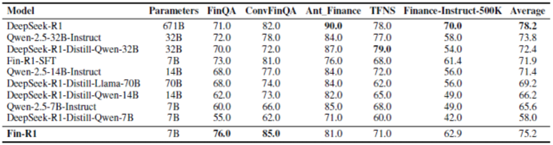
Table 2 Evaluation performance of Fin-R1 and other models on various datasets
6. Model Deployment
Github now offers a "ready-to-use" localization deployment solution. By simply running an installation script, you can easily deploy the Fin-R1 model on a single 4090 graphics card. Whether for bank risk control or quantitative trading, users can quickly get started and solve various financial scenario problems, truly realizing "one-click deployment, making financial AI accessible"!
7. Scene Application
Fin-R1 demonstrates multi-scenario adaptability in the financial sector: it can easily handle complex computational tasks such as trading system code generation, DCF valuation, and options pricing, and it also supports English financial calculations to assist with cross-border business analysis. In terms of financial security and compliance, Fin-R1 acts as a "risk control guardian" by monitoring trading anomalies in real time; in the field of intelligent risk control, its dynamic credit scoring model makes risk assessment more accurate. At the same time, Fin-R1 can assist in generating ESG reports that comply with GRI standards, facilitating the green transformation of enterprises. These application scenarios can all be viewed on GitHub.
8. Summary
Fin-R1 is open source from the training framework to model weights, with low computational resource requirements, suitable for deployment on personal computers, making it more applicable to financial scenarios. Through a two-stage training framework, it addresses issues such as the fragmentation of financial data and uncontrollable inference logic, performing excellently in major financial benchmark tests, demonstrating strong inference capabilities and business generalization ability, providing strong support for the intelligent development of finance.