---The Application of Deep Learning in the Perception System of Autonomous Driving
On October 20, 2020, Xu Hang, Chief Engineer of Huawei Noah's Ark Laboratory, was invited to our institute to give a lecture on the theme of "Application of Deep Learning in the Perception System of Autonomous Driving" at an industry forum. Mr. Xu Hang graduated from the University of Hong Kong with a PhD in Statistics. I joined Noah's Laboratory in 2018 and previously worked as an intern in computational vision research at SenseTime. I have published over ten papers at top artificial intelligence conferences such as NeurIPS, CVPR, ICCV, ECCV, and AAAI, as well as multiple papers in statistical journals such as CSDA and Statistical Computing.
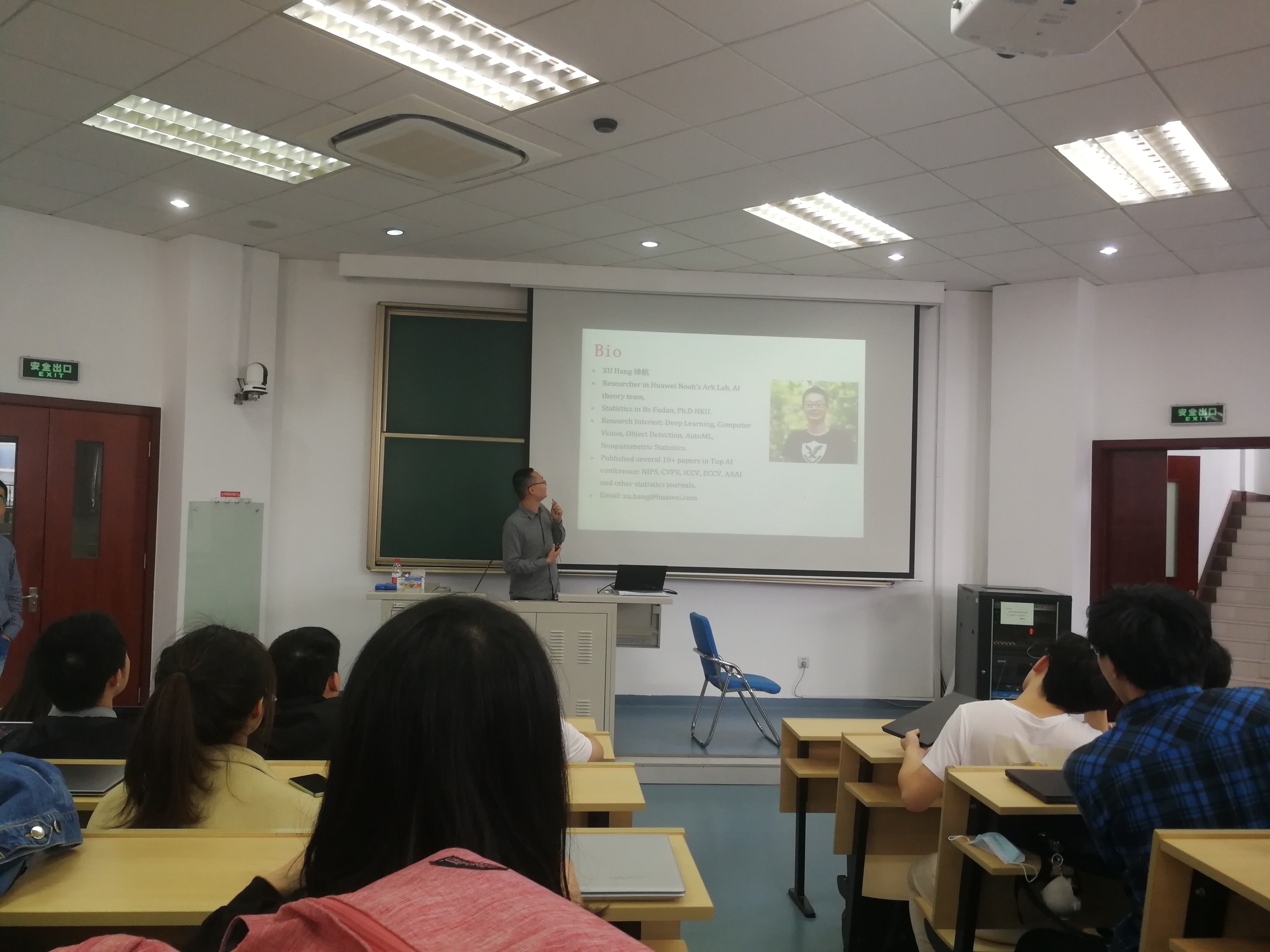
Firstly, Professor Xu Hang introduced the concept and development history of L0 to L5 level driving, as well as the current level of research on autonomous driving. In the autonomous driving perception system of unmanned vehicles, sensors are the main source of data, with various types such as laser radar, visual cameras, millimeter wave radar, etc.
In addition, object detection algorithms in deep learning play a very important role in autonomous driving. Professor Xu Hang introduced the basic principles of convolutional neural network algorithms and focused on the difficulty of 3D object selection in the autonomous driving detection process. In the case of 2D detection, for model training, image annotation only requires position and size information, but in the case of 3D, specific orientation is also required. To address this issue, the industry mainly defines some commonly used car models in the actual annotation process, and uses models of different car models to select and annotate data in 3D state. Currently, good practical results have been achieved.
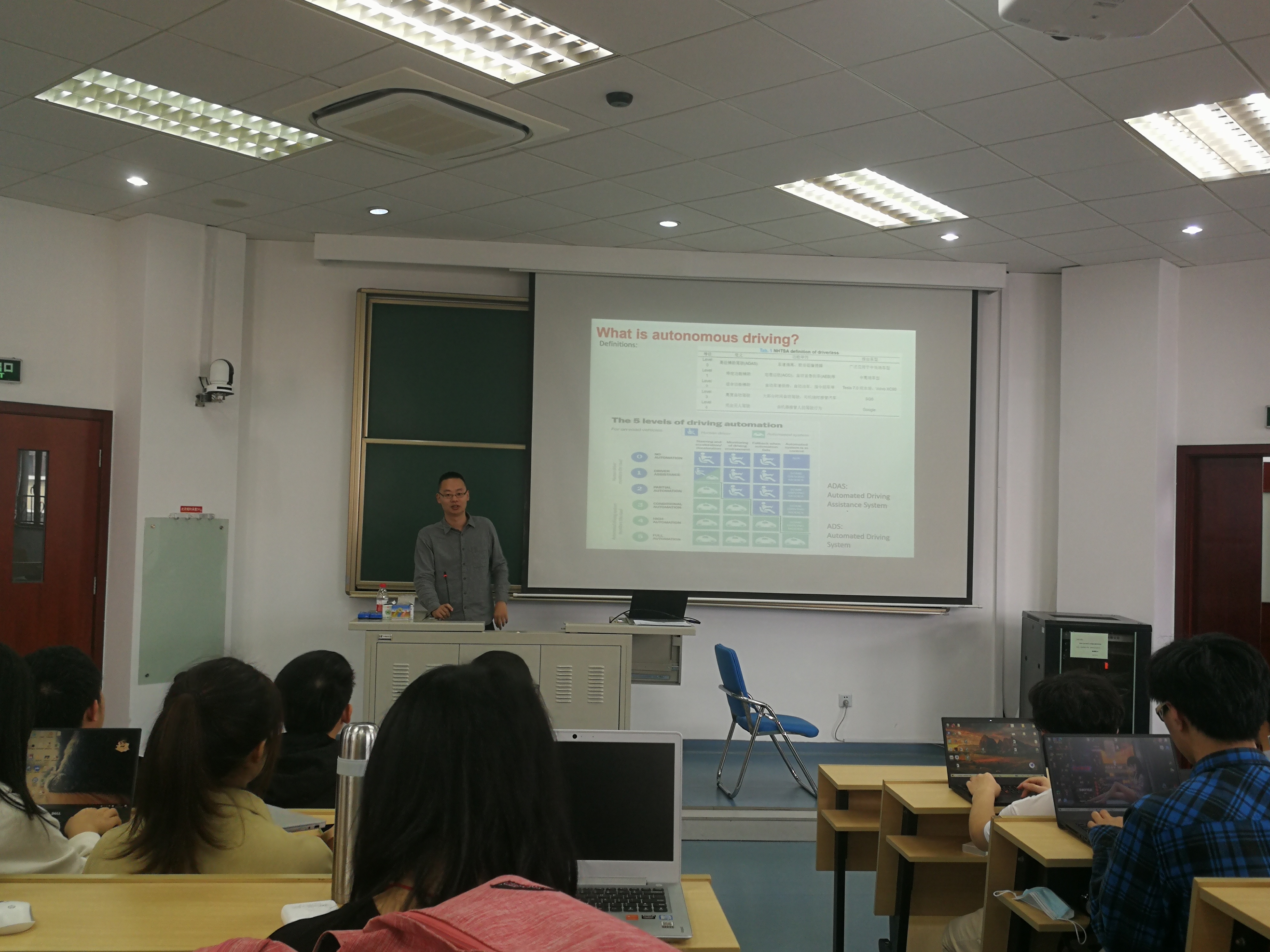
During the operation of autonomous vehicles, there are several detection tasks, including obstacle detection, segmentation of drivable road surfaces, and lane line detection. At the same time, Teacher Xu Hang played a demo video vividly demonstrating the processing effect of point clouds. 3D point clouds and visual camera methods each have their own advantages and disadvantages. Currently, there are multiple fusion strategies in the industry that can solve the problems of the two methods. Teacher Xu Hang introduced us to three methods of strategy fusion.
At the same time, Professor Xu Hang also pointed out that the research on autonomous driving faces many challenges. Firstly, all detection results need to be carried out in real time, constantly sensing the road conditions. Therefore, the requirements for detection accuracy and speed are very high, 30-40 frames per second. At the same time, due to the power consumption problem of chips, improvements have been explored. In addition, facing a wide variety of long tail scenarios with low probability of occurrence or sudden incidents, such as vehicles running red lights and illegally parked vehicles, these unconventional scenarios are difficult to handle and have a small sample content. Data needs to be obtained through simulated scenarios or real road tests. Finally, deep neural network models are complex with billions of parameters, making it difficult to interpret results and locate problems in such a black box state.
During the questioning session, students also actively asked questions about the current development status of autonomous driving, industry achievements sharing, and some specific practical model discrimination issues. Teacher Xu Hang provided detailed answers and elaborated on the current situation and characteristics of the autonomous driving field.
Image provided by: Zhang Yaqi
Contributors: Hu Yifan, Duan Liangjie, Xu Shan