---Digital Transformation and Statistical Challenges and Innovation
On December 1, 2020, Professor Xu Xianchun, Director of the China Economic and Social Data Research Center at Tsinghua University and a professor at the School of Economics and Management, was invited to give a lecture at our institute on the theme of "Digital Transformation and Statistical Challenges and Innovation" at an industry forum. Professor Xu Xianchun has served as the Deputy Director of the National Bureau of Statistics and Vice President of the Chinese Statistical Society. He has been engaged in theoretical research and practical work in Chinese government statistics for a long time, and has presided over multiple major and key projects of the National Social Science Fund. He has published multiple personal monographs and accumulated rich experience in the research of Chinese economic and social data. In this forum, Professor Xu Xianchun introduced the challenges brought by digital transformation to economic and social statistics theory, statistical survey system methods, and statistical standards, and elaborated on how economic and social statistics can achieve innovation in various aspects to meet the needs of the digital age.
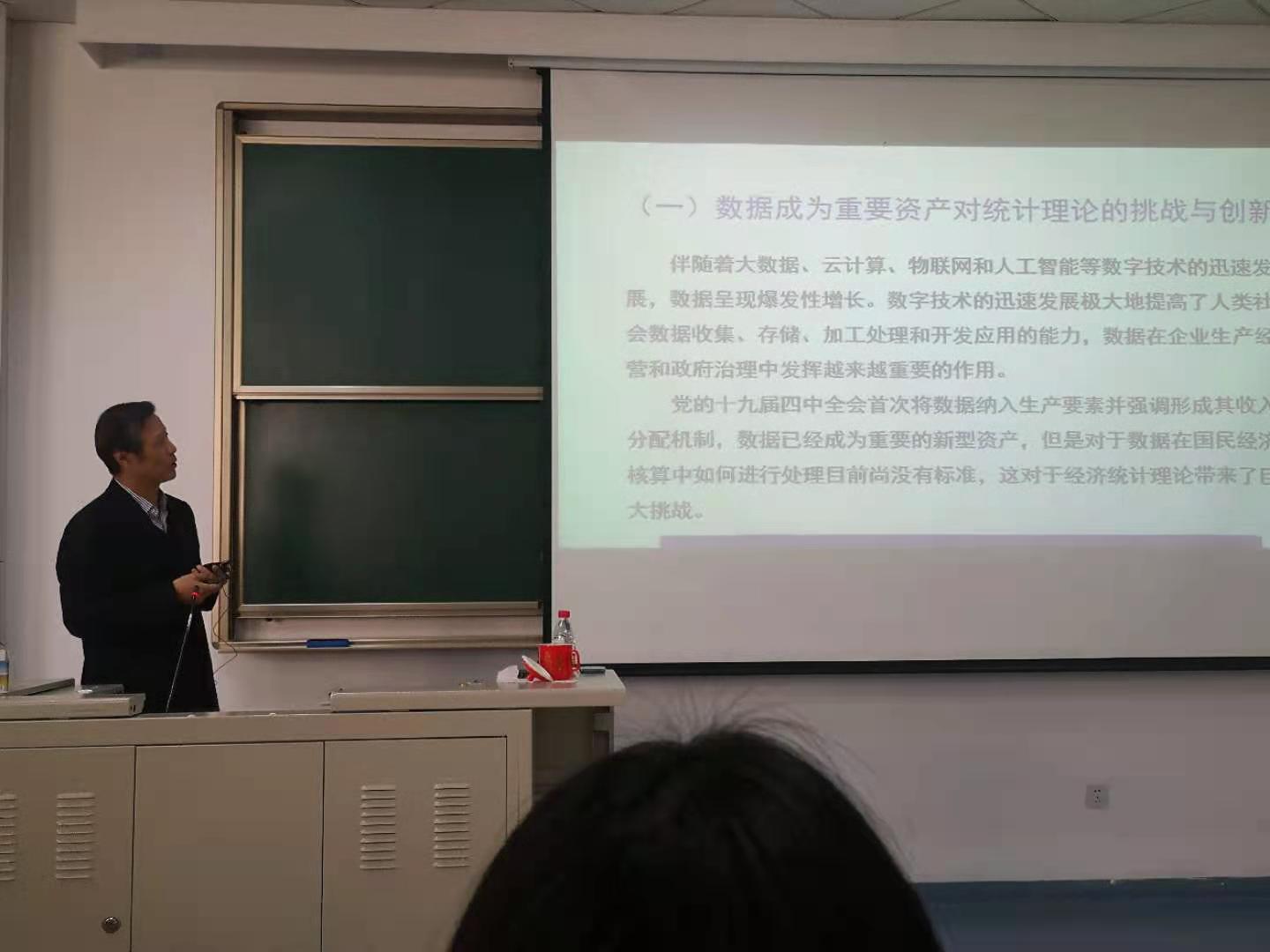
Firstly, Professor Xu Xianchun introduced the concept of digital transformation through many new digital phenomena in the economy and society, such as data becoming an important asset, online live streaming tipping, sharing economy, etc., which then led to a series of challenges faced by statistics in the economy and society, including severe challenges to statistical theory and applications. In the context of digital transformation, economic statistics urgently need innovation.
Next, Professor Xu Xianchun elaborated on the challenges and innovations of digital transformation in four aspects: statistical theory, statistical survey system methods, statistical standards, and statistical applications. In terms of statistical theory, data has become an important asset, but there is currently no standard for how data is processed in national economic accounting. Data, as an important asset, poses challenges to investment statistics, consumption statistics, and income statistics. There is an urgent need to conduct research on data asset statistics and accounting issues, mainly in the fields of production, investment, consumption, and income statistics. Economic statistics and national economic accounting research paradigms need to be applied.
Then, Professor Xu Xianchun talked about the challenges and innovations of business profit model innovation to statistical theory. Taking Tencent as an example, it belongs to Tencent's underlying business. Provide free services to consumers. At the same time, by gathering user traffic through free services, it brings a continuous stream of customers to its financial, advertising, gaming and other businesses. Tencent has made huge profits through this business. The innovation of this enterprise profit model will pose challenges and innovations to production statistics theory, consumption statistics theory, and income statistics theory.
In addition, other aspects will also pose challenges and innovations to statistical theory, such as the challenges and innovations brought by online live streaming tipping to statistical theory, the challenges and innovations brought by digital transformation to price statistics, the challenges brought by the sharing economy to the classification of durable goods and investment products, and the challenges brought by entertainment, cultural, and art components to investment statistics.
Professor Xu Xianchun also emphasized the challenges and innovations that digital transformation will bring to statistical survey systems and methods. For example, the sharing economy poses challenges to the methods of production statistics and surveys, and exploring the use of platform big data to monitor individual and household production activities; For example, with the widening income distribution gap accompanying digital transformation, it is necessary to explore the use of big data to enhance the representativeness of income surveys. Digital technology naturally blocks some social groups from entering new fields and has also given rise to a series of job types, such as programmers, game designers, algorithm analysts, etc.
Finally, Professor Xu Xianchun elaborated on the challenges and innovations of digital transformation on statistical standards and applications. In the context of digital transformation, new industries, new formats, and new business models continue to emerge and develop rapidly, and the revision cycle of national economic industry classifications needs to be further shortened; And in the context of the digital economy, the integration between traditional industries and the digital economy continues to deepen, with many new economic activities intertwined with traditional economic activities, posing difficulties for statistical analysis; Secondly, with the rise of "gig workers" who engage in short-term work, traditional employment statistics standards are challenged due to the uncertainty of the jobs and income obtained; Once again, with the development of the economy and society, technological progress, and industrial restructuring and upgrading, China's social and occupational structure has undergone significant changes, with new professions constantly emerging.
With the wide penetration of the Internet, mobile Internet and Internet of Things in the lives of residents and production activities of enterprises, the digitalization of the economic society has brought massive and high-frequency data, and big data has brought a series of challenges to the government. First, the authoritative position of government statistics has been challenged. The second challenge is the statistical survey system of government statistics. The third challenge is the data processing mode of government statistics. The era of big data is both an opportunity and a challenge, and it is the same for the government. The government should also seize the opportunity to further innovate and develop: firstly, promote the construction of mechanisms for big data sharing. The second is to ensure the representativeness and quality of the data. The third is to build big data processing and analysis capabilities.
Contributors: Lv Yijing, Chen Tiantian, Zhou Jieyuan
Image provided by: Xu Zhaoyang