The Application of Big Data Decision Making and Machine Learning Models in Commercial Banks
On March 30, 2021, Dr. Ning Wenqiang, Senior Manager of Data Analysis at Gaowo Information Technology (Shanghai) Co., Ltd., was invited to our institute to give a lecture on the theme of "Application of Big Data Decision Making and Machine Learning Models in Commercial Banks" at an industry forum. Dr. Ning Wenqiang, as the Senior Manager of Data Analysis in the Risk Management Department of Discover Financial Services Co., Ltd., has over ten years of experience in big data analysis and commercial bank risk management. He has accumulated rich project experience and customer cases in the credit card product market and risk management, model application, business intelligence, and process optimization.
In this forum lecture, Dr. Ning Wenqiang introduced the application scenarios and methodologies of big data decision-making and machine learning models in various specific businesses of commercial banks. At the same time, the general process and some common misconceptions of using big data analysis to solve business problems were introduced.
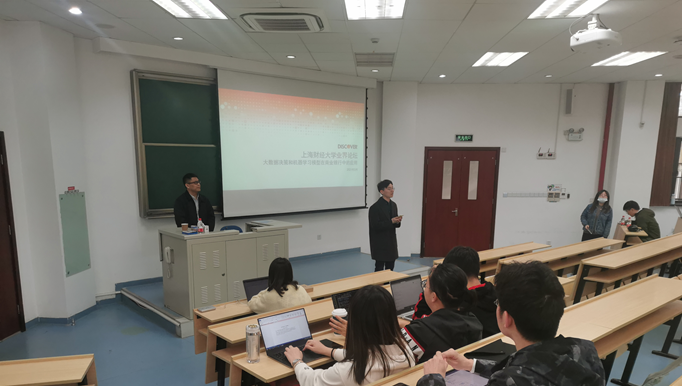
Firstly, Dr. Ning Wenqiang introduced the specific situation of Discover Financial Services Limited and its advantages. DFS is a S&P 500 index company with globally leading banking and payment services businesses, and is one of the most well-known brands in the financial services industry. DFS is one of the largest issuers of credit cards, personal loans, and student loans in the United States, with its credit card payment network spanning 185 countries and regions. Its Shanghai based Center of Excellence focuses on data-driven decision analysis, utilizing cutting-edge analytical techniques to provide business solutions for marketing, risk management, and operations of various products and services to support the company's strategic and business decisions. It is committed to becoming the best financial service analysis center in China. Later, Dr. Ning Wenqiang took big data as the topic, vividly illustrating the differences between today's big data and previous data from three aspects: Volume, Variety, and Velocity, as well as the challenges it currently faces. The key to big data is the ability to quickly obtain useful information from large amounts of data, or the ability to quickly monetize big data assets, that is, big data - small data - useful information.
The domestic big data financial model is widely used in e-commerce platforms. There are currently two main models: the big data finance platform model, represented by Alibaba Microfinance; The supply chain finance model, represented by JD.com and Suning (the future big data finance model will be diversified).
Nowadays, traditional financial institutions are accelerating the effective utilization of accumulated data through big data. However, due to past data being too scattered, with a single source, monotonous form, and unable to reflect customers' trading behavior, preferences, and habits, the ability of traditional financial institutions to apply data has been constrained.
Afterwards, Dr. Ning Wenqiang made some prospects for future big data applications, such as the establishment of the central bank credit system, cooperation between financial institutions and e-commerce platforms, and integration of big data from the three major operators. Big data finance is the most promising direction for the development of Internet finance in the future. In the future, big data credit reporting can be led by the government, with multiple partners working together to promote it. Big data rating can be achieved through traffic accumulation, data mining, industry chain cooperation, and other methods. Big data rating will be beneficial for upgrading the current rating model and benefiting multiple parties. Big data risk control is the key for the future Internet financial platform to occupy high ground, optimize processes, improve efficiency and develop steadily.
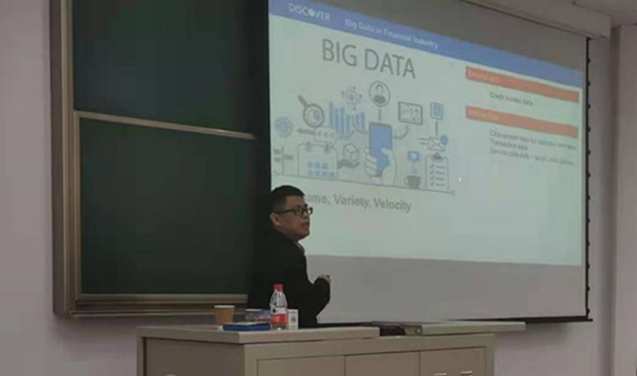
Scoring consumer credit, as a semi public product that involves the vital rights and interests of consumers, not only requires sufficient predictive accuracy, but also interpretability. Although artificial intelligence technology can improve the accuracy of credit evaluation, its learning process is very complex, and even programmers cannot fully understand how machines learn and how they obtain results through learning. This "black box" characteristic makes deep learning unsuitable for application in personal credit scoring, and challenges its popularity in the field of credit reporting. Based on this, Dr. Ning Wenqiang has provided a detailed introduction to how the industry currently utilizes diverse data for risk control and precision marketing.
Then Dr. Ning Wenqiang provided a detailed explanation of the general process and common misconceptions of using big data analysis to solve business problems, mainly including:
How to clarify the actual purpose in complex practical applications;
What are the differences between data collection methods and traditional methods in today's era of big data popularity, what are the challenges, and how should we collect and process massive amounts of data.
How to build a good model for massive data and present the data.
And how to collect massive data by means of mobile Internet or other relevant software, organize the data to form information, then integrate and refine the relevant information, and form an automated decision-making model after training and fitting on the basis of the data.
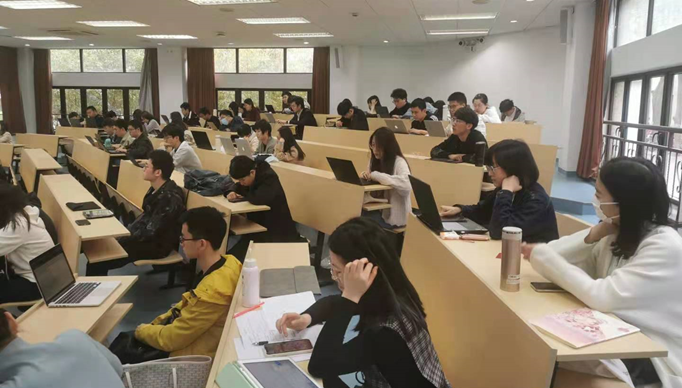
In the final questioning session, the students also actively asked questions. Dr. Ning Wenqiang provided very detailed answers to issues such as employment and big data development. Through this explanation, the students gained a lot and gained more understanding and knowledge about the application of big data and machine learning in the industry.
Contributors: Liu Yupei, Liu Zheng, Guo Weilun
Image provided by: Yang Shaojun