---Industrial transformation in the era of big data and intelligence
On April 13, 2021, Professor Shu Hong, Vice President and Chief Information Officer of Dongfang Securities, was invited to our institute to give a lecture on the industry forum with the theme of "Industrial Transformation in the Era of Big Data and Intelligence". As the Vice President and Chief Information Officer of Dongfang Securities, Professor Shu Hong has extensive experience in IT system design, software development, and project management. He has won multiple research awards for the transformation of high-tech achievements in Shanghai. Based on his rich experience, Teacher Shu Hong answered the following question: What kind of thinking revolution does the era of big data bring? What is the logic behind this artificial intelligence craze? In today's rapidly developing new generation of information technology, what response strategies should financial institutions adopt? What should students look like to face future work challenges?
If we consider capital and mechanical energy as the driving force behind the reliance on global modernization in the Age of Discovery, then big data is the core driving force behind the intelligent revolution we are currently experiencing. In history, major changes have been accompanied by revolutions in thinking. From a human perspective, enterprises that adjust their thinking in a timely manner have achieved long-term progress and development. The intelligent revolution is subtly changing people's way of thinking and doing things, and we need to keep up with the pace of the times in our thinking. Financial institutions, as information technology intensive industries, are particularly sensitive to the changes brought about by the technological revolution, and fintech is reshaping the modern financial industry with unprecedented enthusiasm.
Firstly, Professor Shu Hong taught us the history of information technology development. Information technology mainly includes sensing technology, computer and intelligent technology, communication technology, and control technology. Nowadays, cloud computing, mobility, networking, and big data technologies are constantly moving towards deep integration, and the core position of big data and artificial intelligence in IT architecture is increasingly emerging. Teacher Shu Hong also introduced the characteristics of the big data era, pointing out that the most significant feature of the big data era is the explosive growth of data, with more data generated in the past three years than in the past 40000 years. In addition, the era of big data also has four "V" characteristics: large volume, strong diversity, fast speed, and high value density.
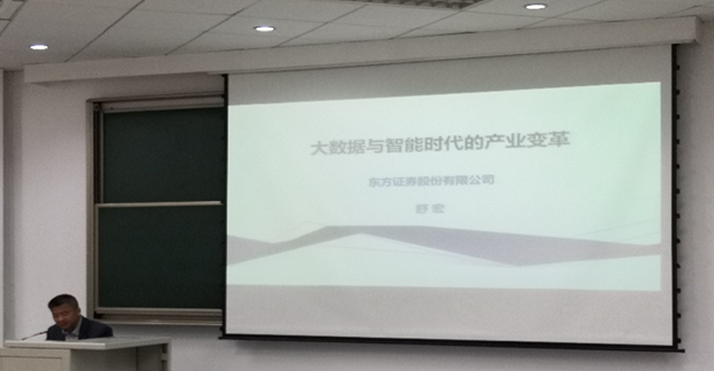
Teacher Shu Hong further explained the thinking revolution triggered by big data. Mechanical thinking, also known as mind driven thinking, is the most common way of thinking in the past three centuries. In the past, people often believed that the laws of world change were deterministic and could be described clearly with simple formulas or language. These laws could be applied to various unknown fields to guide practice. The path of data-driven thinking is from data to conclusions, rather than inferring data from conclusions. Under this type of thinking, the world is full of uncertainty, and big data can be used to eliminate uncertainty and replace the inevitability of causal relationships with the correlation of data. Comparing these two modes of thinking, data thinking is suitable for situations with large amounts of data and good data representativeness. Its advantage is that it does not require professional knowledge and replaces causality with correlation. The disadvantage is that phenomena that have not been presented in the data cannot be learned; Mechanical thinking is suitable for scenarios with clear principles and logical content, and has the advantages of comprehensibility, interpretability, and strong stability. The disadvantage is that it requires knowledge from experts, is expensive, and difficult to promote. Teacher Shu Hong also listed several practical applications of big data, including Google's successful prediction of the spread of the 2009 winter flu using big data, Steve Jobs' use of big data for targeted gene therapy, and the successful prediction of 21 Oscars using big data.
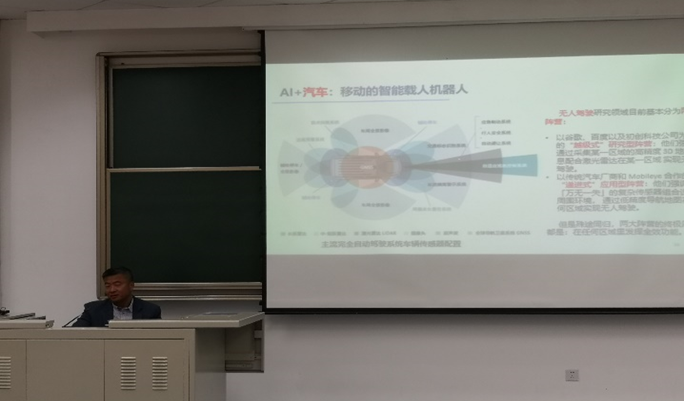
Finally, Professor Shu Hong and his classmates explored the reasons behind the artificial intelligence craze. Firstly, it was explained that the evolutionary history of artificial intelligence can be divided into the semiotic school, the control school, and the connectivity school that includes neural networks and deep learning. The three main stages of artificial intelligence are computational intelligence, perceptual intelligence, and cognitive intelligence. Continuing, Professor Shu Hong pointed out that the current explosion of artificial intelligence applications is the result of the combined effects of algorithms, computing power, and big data. Informationization, cloud computing, big data, and artificial intelligence are the inevitable order of industrial development. Without data, there can be no AI. An AI open platform must be supported by cloud technology.
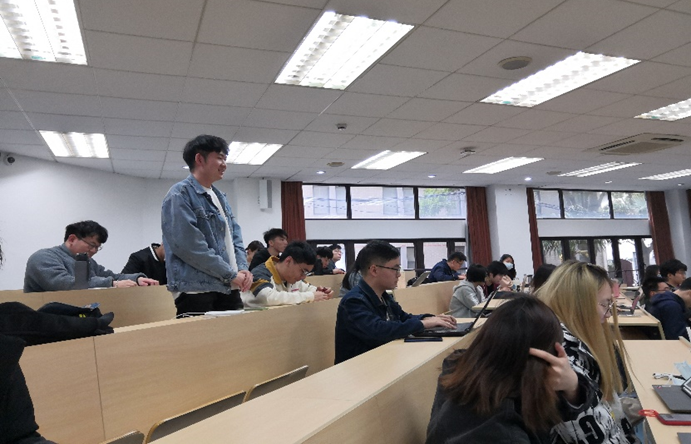
During the questioning session, the students actively and enthusiastically discussed with the teacher how to face the issues of information security and information leakage in the era of artificial intelligence, as well as the new requirements of enterprises for talents in the intelligent era. Teacher Shu Hong gave many practical suggestions on which aspects we should focus on to improve our abilities, and the students all gained a lot.
Contributors: Tang Jiaqi, Dong Zhiying, Cai Yuheng
Image provided by: Chen Yaxin