---Statistical Thinking and Statistical Leadership in Drug Development
On April 20, 2021, Dr. Xiaoni Liu, the current head and executive director of Novartis' analysis department in China, brought us an industry forum on the theme of "Statistical Thinking and Statistical Leadership in Drug Development". Dr. Liu Xiaoni graduated from the Department of Statistics at North Carolina State University in the United States and obtained a Ph.D. in Statistics. She leads Novartis China's biostatistics teams located in Shanghai and Beijing. In recent years, China's drug research and development has been advancing rapidly, while the global pharmaceutical and health field is undergoing significant changes. These changes have brought about the application of various advanced technologies and data science in the field of medicine, as well as enormous opportunities and challenges for statisticians. In this lecture, Dr. Liu Xiaoni will introduce the crucial role of statistics in drug development. At the same time, we will discuss with everyone how to develop and apply statistical thinking and statistical leadership to promote the progress of drug research and development in the current opportunities and challenges.
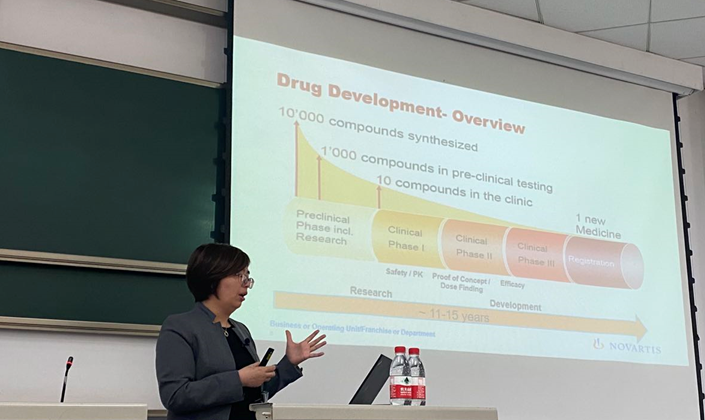
Firstly, Dr. Liu Xiaoni introduced the disaster of thalidomide, highlighting that the process of drug development is very complex and has a high failure rate. The development of a drug requires three phases of clinical development. In order to increase the efficiency of drug development, statistical thinking is introduced into clinical trials to ensure that the decisions made are optimal based on existing data. In the first phase of the trial, the focus was on pharmacokinetics and pharmacodynamics, and the maximum limiting toxicity to the experimental receptor was determined through statistical methods. In the second phase of clinical practice, the first step is to apply conceptual proof of concept trials to patients, in order to calculate minimum and target differences. Innovative statistical methods are used to complete the trials at the lowest possible cost; The second step is to conduct dose exploration research based on the experimental results, calculating the minimum dose that can achieve drug efficacy and the maximum dose that ensures drug safety.
In the third phase experiment, the primary objective is to determine effectiveness and safety. This includes many statistical problems, and Dr. Liu Xiaoni listed two common statistical problems: one is multiple testing, which can cause bias in the final estimate and increase the first type of error. The second is adaptive design: mid-term analysis is inserted into the experiment to verify whether the previous hypothesis is correct. If the hypothesis is found to be different from the previous one, corresponding adjustments are made to the previous hypothesis. In addition, missing data, gene analysis, and so on will all require statistical knowledge applications. Dr. Liu Xiaoni mentioned using statistical knowledge to achieve two main goals: firstly, how to apply the collected data to clinical medicine; The second is how to provide drugs with better treatment effects based on the specific situation of the patient, in order to achieve precision medicine. In addition, the application of machine learning in drug development is also highlighted: 1. Selecting suitable populations 2. Disease visualization 3. Node selection 4. Classification of basic variables 5. Subgram analysis. The core idea is to make drug development more effective and achieve precision medicine in the era of big data.
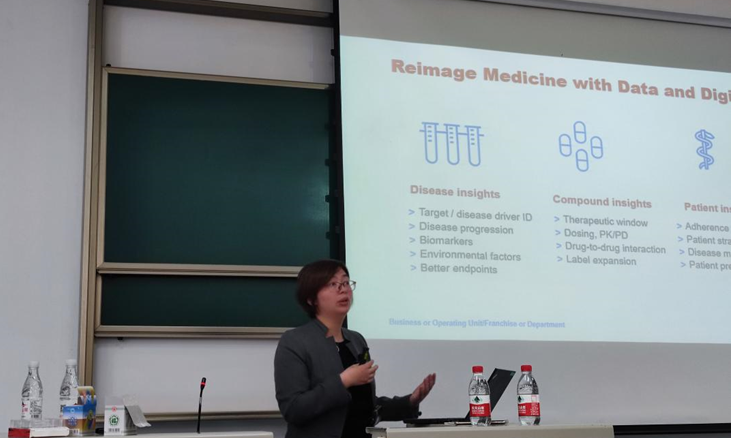
Secondly, Dr. Liu elaborated on the meaning of statistical leadership. As a leader, Dr. Liu believes in having a mindset of growth and collaboration, having enough patience to listen, and enough wisdom to know what the key points are. It is very important to understand the important information conveyed by doctors or professionals from other departments and how to express what one wants to know. At the same time, it is necessary to learn more about data science, machine learning, and drug dosimetry, and understand their respective advantages. There are also some hardcore skills required: statistical techniques, learning ability, drug development experience, and effective communication.
Finally, Dr. Liu concluded that drug development generally takes a long time, and very few of the initial plans and drugs can be marketed and produced. Therefore, one of the responsibilities of statisticians is to find suitable plans or models to shorten the time of this process. Another direction for future development is how to achieve precision medicine, which involves finding the most suitable population for a certain drug through effective methods to achieve the best results and reduce social burden.
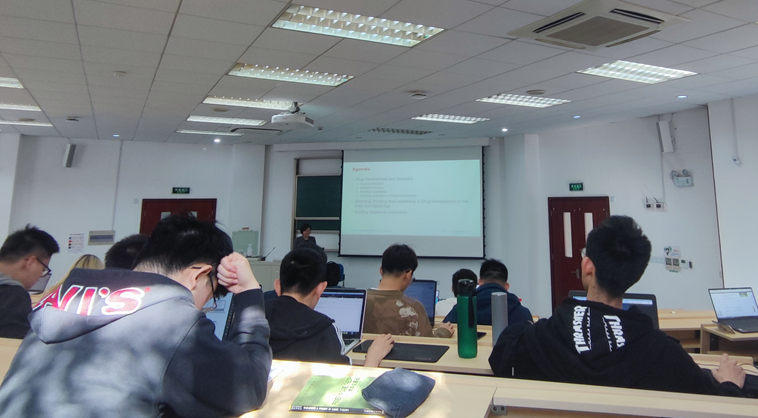
During the questioning session, students discussed whether there was a dedicated team to handle medical data and the characteristics of talent needed. Dr. Liu provided valuable advice to the students, and they gained a lot from it.
Contributors: Liu Siyan, Rong Sheng, Li Shengmao
Image provided by: Dai Lulu