——Quantitative Risk Management in Credit
On March 7, 2023, Professor Wang Zhengyang, currently the Deputy Director of Risk in the Re lending Strategy Department of Jiayin Jinko, was invited to our institute to give a lecture on the theme of "Quantitative Risk Management in Credit" at an industry forum.
Mr. Wang Zhengyang once worked in the head education loan company in the United States and HSBC Bank in the United States. After returning to China in 2016, he joined the Internet financial industry, and successively engaged in risk management in the head American stock listed mutual fund companies, such as auction loans, money digging, 360 IOUs, and You Me Loans. In this forum, Professor Wang Zhengyang introduced the core concepts of risk management in the credit industry, the types of risks that exist in credit, and how to carry out corresponding risk management.
At the beginning of the forum, Teacher Wang Zhengyang first introduced the corporate responsibility and vision of Jiayin Jinko as a financial technology innovation service enterprise. It aims to use innovative technology to shorten the distance between users and financial services, provide efficient and intelligent inclusive financial services for users, and give everyone a certain understanding of Jiayin Jinko.
Then Teacher Wang introduced the types of credit risks, including fraud risk, credit risk, operational risk, and market risk. Among them, fraud risk includes identity forgery, information fraud, gang fraud, and non personal use of credit; Credit risk includes risk stratification, risk exposure, default losses, and asset structure; Operational risks include strategy deployment, strategy analysis, model selection, and data loss; Market risks include cyclical fluctuations, policy impacts, competitor impacts, and customer concentration.
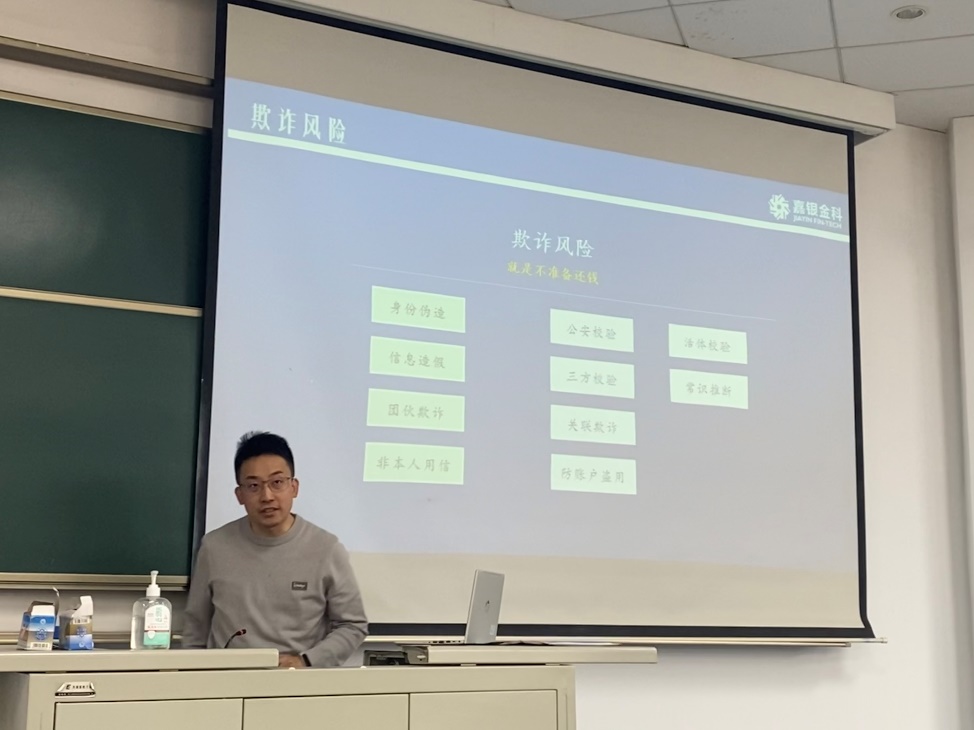
Next, Teacher Wang introduced the process and risks. Taking the process of new customer channels as an example, the first step is channel pre screening, which includes customer group qualifications, multi head exclusion, People's Bank of China credit reporting, and traffic distribution. Then there is anti fraud approval, which requires identity verification and blacklist comparison to prevent related fraud and device fraud. Next, model scoring is carried out, followed by strategic decision-making, including risk admission, risk stratification, and grant making. After that, post fraud and collection are carried out. The above together constitute a new customer's credit process and corresponding risk management.
Finally, Teacher Wang talked about risk management and business operations. It discusses the issues of high risk and high return versus low risk and low return, introducing that risk control is to minimize risks as much as possible, while risk management is to control risks within a reasonable range and obtain sustained and stable returns. Pre emptive risk management is the competitive advantage of Jiayin Jinko compared to other companies.

During the questioning session, the students were very enthusiastic and asked questions related to credit risk management interviews and the required skills for engaging in this industry. Teacher Wang Zhengyang patiently answered the questions and suggested that the students first determine whether to pursue a strategic or model direction. If the strategic direction focuses on technology, the model direction will also involve communication with other departments. Through this industry forum, students have gained a deeper understanding of credit risk management.
Author: Gao Feng
Image provided by: Deng Yuanyuan