On the afternoon of June 3, 2025, the "Industry Forum" of Shanghai University of Finance and Economics successfully held a special lecture on "There are also" tricks "for big model applications", and invited He Liang, Executive Dean of Nanjing Laike Intelligent Engineering Research Institute, to be the keynote speaker. The lecture delved into the technical methods and ethical considerations of using big language models in practical applications, providing insightful academic sharing for the teachers and students present.
Dean He Liang pointed out at the beginning that although artificial intelligence technology represented by large models has demonstrated strong capabilities, it still faces many challenges in the actual implementation process. He emphasized that the unstable output quality of the model and the deviation in executing complex tasks have become key bottlenecks restricting the application of technology. It's like working with a talented but quirky assistant, you need to find the right way to communicate, "Dean He Liang said metaphorically.
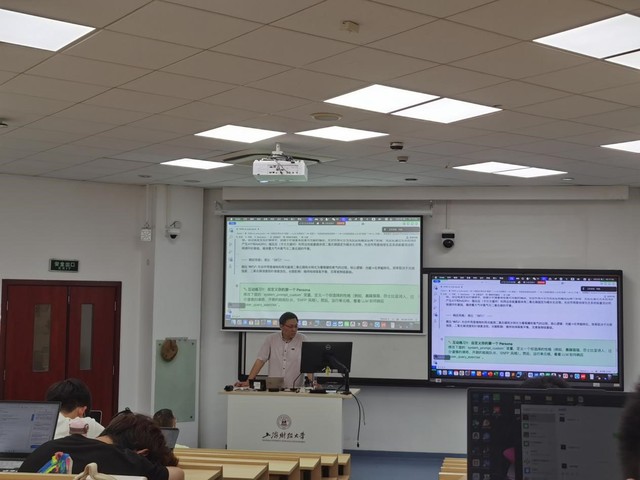
In response to these technical challenges, the lecture system introduced three application modes that have been verified through practice. Firstly, there is the "expert integration mode", which combines large models with professional domain models to form a collaborative system with complementary advantages; Secondly, there is the "knowledge driven mode", which effectively improves the accuracy and reliability of model output by utilizing structured knowledge bases such as knowledge graphs; Finally, there is the 'personality control mode', which utilizes technical means such as system prompts to precisely regulate the expression style of the model.
In terms of technical practice, Dean He Liang explained in detail the key points of the prompt project based on specific cases. He specifically demonstrated how to guide the model to generate output that better meets expectations through carefully designed system prompts. When discussing the application of knowledge graphs, he used multiple fields as examples to demonstrate how to structure professional knowledge and provide reliable factual basis for models. Dean He Liang focused on analyzing the phenomenon of "bias amplification" and pointed out that when models are asked to play specific roles, it may reinforce stereotypes in the training data. He used gender bias in technical positions as an example to illustrate that these implicit biases may be further amplified through model outputs. Technology developers should establish a comprehensive bias detection mechanism, which is not only a technical issue, but also a social responsibility
At the end of the lecture, Dean He Liang looked forward to the future development direction of big model technology, believing that multimodal fusion and intelligent agent collaboration will become important trends. He also reminded that with the improvement of technological capabilities, corresponding ethical norms and governance frameworks need to be simultaneously improved.
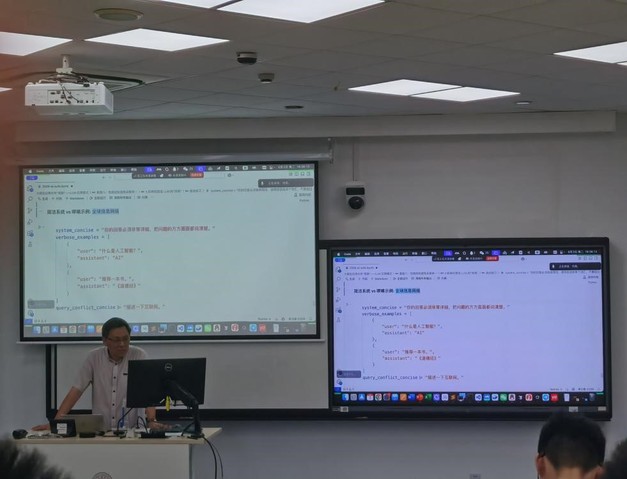
This lecture attracted numerous teachers and students to participate. The lecture content, which focuses on both technological progress and ethical considerations, is of great significance for cultivating digital talents with a sense of social responsibility. Many students expressed that the lecture is both highly theoretical and practical, providing valuable references for their future research on the application of large-scale models.
Author: Cheng Xiayi
Image provided by: Shi Jiahe