On May 8th and 12th, 2021, the Big Data Mining course adopted a "dual teacher" teaching mode and invited Mr. Xu Hong, a researcher at Xingye Trading Futures and Options, to give us two lectures on the theme of "Principles of Blockchain Technology". The Big Data Mining course is offered by Associate Professor Zhang Liwen from the School of Statistics and Management, with the aim of using algorithms to search for information hidden in massive amounts of data, in order to explore the patterns and underlying relationships within it. The course covers technologies such as statistics, machine learning, deep learning, artificial intelligence, recommendation systems, search engines, blockchain, etc. The application of blockchain technology as a distributed database system is becoming increasingly important in various scenarios. In this course, we are also fortunate to invite Mr. Xu Hong, who has rich practical experience, to teach us the principles of blockchain technology, achieving the dual teaching of academia and industry, and making the teaching mode more diversified.
Mr. Xu Hong graduated with a bachelor's degree in Computer Science from Tsinghua University and a master's degree in Finance from Nanyang Technological University. He previously worked in the Information Technology Department of Bank of China and joined Xingye Trading in 2018, mainly engaged in research on commodity futures and options, as well as sales and trading management. In April 2020, he joined Xingye Futures and Pacific Property and Casualty Insurance's agricultural insurance area blockchain innovation project construction. As the main project leader, he is committed to using blockchain technology to build a comprehensive alliance chain platform that spans across the banking, insurance, and securities industries to improve business efficiency. In this lecture, Mr. Xu mainly introduced two major content sections: blockchain and smart contracts. Combining industry trends and his own research and thinking, he explained to the students the technical principles, model architecture, and operation mechanism behind blockchain, and put forward many thoughts on the concept of smart contracts.
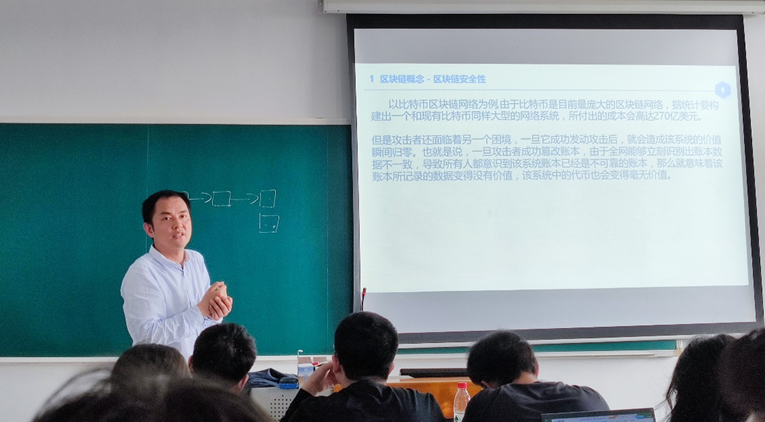
Firstly, Mr. Xu introduced the concept of blockchain and its underlying technology. Blockchain is an important concept of Bitcoin, whose initial mission is to support the formation and circulation of Bitcoin. Essentially, blockchain is a distributed shared database technology solution that utilizes decentralization and trustless methods to collectively maintain the reliability of a data ledger. In the application of Bitcoin, the entire blockchain is the public ledger of Bitcoin, and every node in the network has a backup of Bitcoin transaction information. When a Bitcoin transaction is initiated, the information is broadcasted to the network, and miners who obtain legal accounting rights through computing power competition record the transaction information as a new block connected to the blockchain. Once recorded, the information cannot be tampered with at will.
Then, Mr. Xu introduced us to the model architecture and consensus mechanism of blockchain. Blockchain is naturally a technology for constructing transaction infrastructure. The blockchain system consists of a bottom-up data layer, network layer, consensus layer, incentive layer, contract layer, and application layer, almost every layer integrating mature computer technology. The consensus mechanism of blockchain is an asymmetric encryption algorithm, which uses a "key pair" in the process of encryption and decryption. The two keys in the "key pair" have asymmetric characteristics: one is that after encrypting with one key, only the other key can decrypt it; Secondly, after one of the keys is made public, no one else can calculate the other key based on the publicly available key.
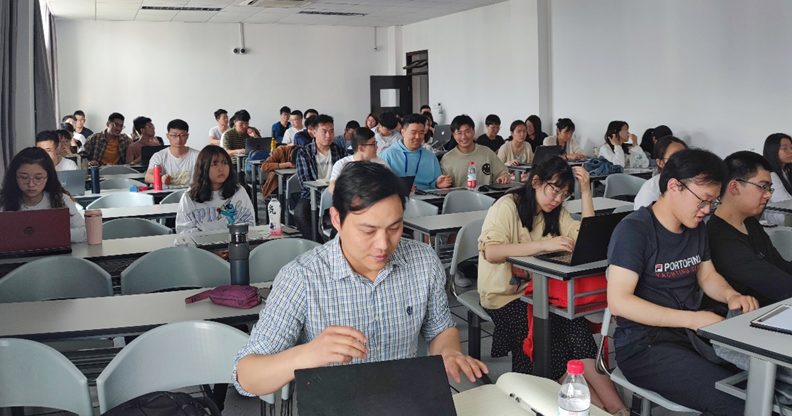
After introducing the basic concepts and technical architecture of blockchain, Mr. Xu further introduced us to the concept of digitizing paper contracts - the development of "smart contracts". The concept of "smart contracts" was proposed by cryptographer Nick Sabo as early as 1994, which is a set of digitally defined commitments, including agreements on which contract participants can execute these commitments. Although theory has long existed, smart contracts have never become a reality due to the lack of a digital financial system that can support programmable transactions so far. And this situation is being changed by the emergence and widespread application of Bitcoin. Because most blockchain based digital currencies are themselves computer programs, smart contracts can interact with them just like they can interact with other programs.
Subsequently, Mr. Xu provided a detailed introduction to the three elements of smart contracts. In the blockchain environment, contracts or smart contracts mean that blockchain transactions will go far beyond simple buying and selling of currency, and there will be a wider range of instructions embedded in the blockchain. Firstly, it will have autonomous characteristics, as the contract will automatically run once initiated without any intervention from its initiator; Secondly, self-sufficiency refers to the ability of smart contracts to acquire resources on their own by providing services or issuing assets to obtain funds, which they will also use when needed; Finally, it will also integrate the most important feature of blockchain, decentralization, which means that smart contracts do not rely on a single centralized server, but are distributed and run automatically through network nodes. Here, Mr. Xu also emphasized the important difference between smart contracts and blockchain, that is, blockchain does not exchange information with the outside world, but the triggering of smart contracts comes from external information, which also makes smart contracts less secure than blockchain.
Finally, in order to help students understand the application value of smart contracts, Mr. Xu also demonstrated the role that smart contracts can play in scenarios such as gambling trading, mortgage loans, online shopping, and over-the-counter derivatives, based on practical cases. It can be foreseen that smart contracts based on blockchain technology will have broad application prospects in the future financial field.
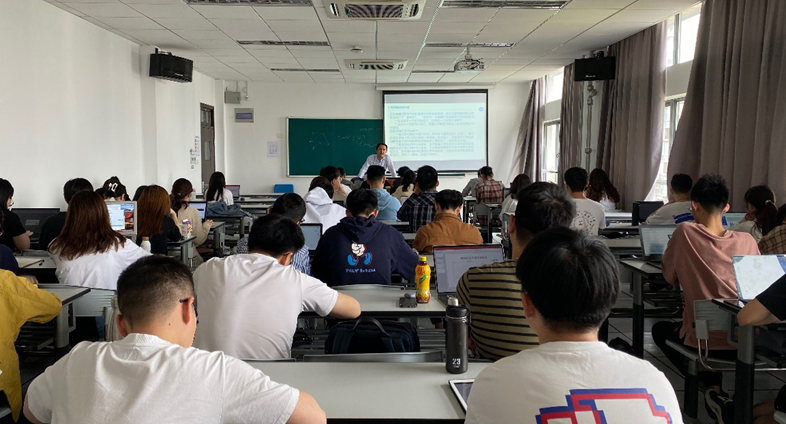
During the questioning session, students discussed and asked questions about the application areas and future development of blockchain, and Teacher Xu Hong answered each question for them. Through the two special lectures brought by Professor Xu Hong, students have gained a deeper understanding of the principles of blockchain and have gained a lot. At the same time, through the teaching mode of dual teachers in one classroom, the course has become a small seminar that combines theory and practice, with full interaction between teachers and students, allowing students to broaden their horizons, learn more practical knowledge, and gain dual benefits.
Contributors: Chen Yuehu, Yang Shaojun, Liu Xiaoya
Image provided by: Dai Lulu