---The application of statistical and data science knowledge in climate related financial risk stress testing
On the afternoon of October 11, 2022, the college was honored to invite Ms. Jin Minzhou, Risk Management Manager of EY Hong Kong Financial Services, to give a lecture on the application of statistical and data science knowledge in climate related financial risk stress testing.
Professor Jin Minzhou holds a Bachelor's degree in Economics from Fudan University and a Master's degree in Economics from the University of Pennsylvania in the United States. Obtain FRM certification. The current EY Hong Kong Financial Services Risk Management Manager has over 7 years of work experience in credit risk management, familiar with climate risk, internal rating models, stress testing, internal rating model applications, policies and systems, and IFRS 9. In the field of green finance, Ms. Jin has provided services to several large Chinese joint-stock commercial banks, responsible for conducting stress tests on transformation risks and physical risks, integrating internal evaluation models and credit risk impairment models, and preparing the Hong Kong Monetary Authority's climate risk stress testing application template.
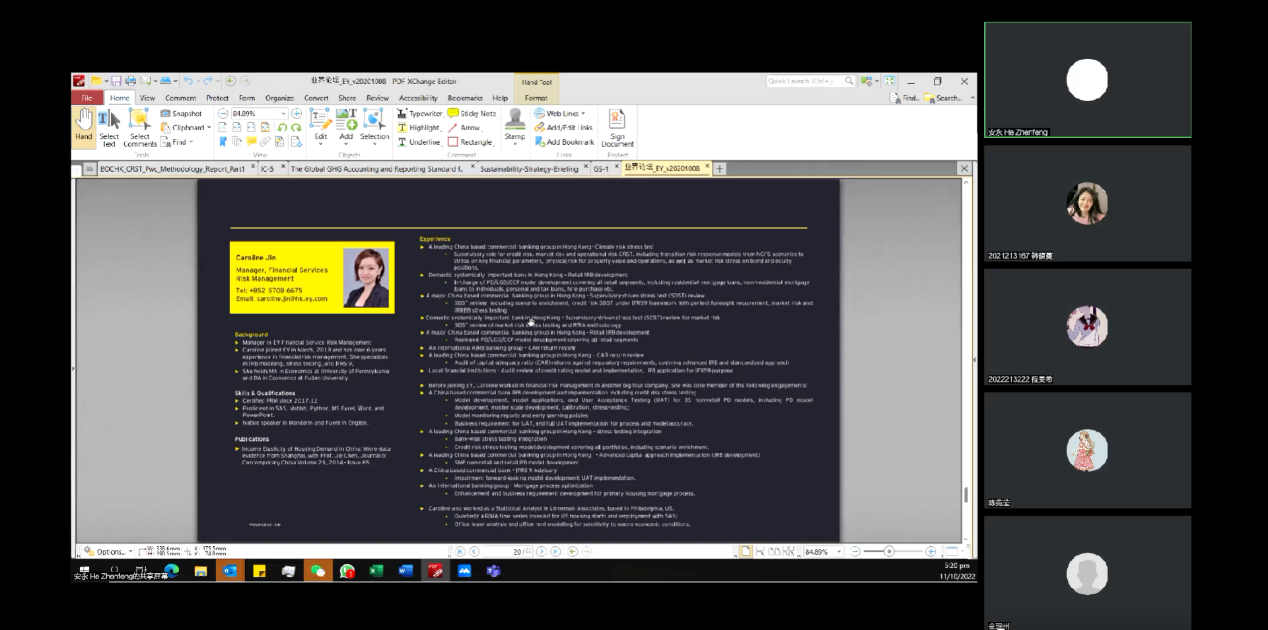
At the beginning of the forum, Teacher Jin Minzhou first introduced the company situation of Ernst&Young, which not only covers audit business, but also consulting business, strategy, transaction business, and tax business. Her financial service risk business team belongs to the business consulting business under the consulting business. At the same time, financial service risk business includes financial compliance risk, anti money laundering, anti money laundering business, and financial risk management.
In this forum, Teacher Jin mainly introduced the application of statistics and data analysis in risk management of commercial banks, and detailed the main risks faced by commercial banks, including credit risk, market risk, operational risk, liquidity risk, concentration risk, and other risks. The main risks among them are credit risk and market risk. Credit risk refers to the risk of losses incurred by a bank's counterparty or borrower in fulfilling contractual obligations, while market risk refers to the risk of asset losses caused by fluctuations in market prices. The data analysis model of commercial banks is mainly designed to serve various business needs and regulatory requirements. There are a large number of models developed and maintained by banks as a whole. Taking the bank wide stress testing as an example, stress testing is a financial risk management tool and means used to evaluate the bank's ability to withstand various risks in unfavorable operating environments, thereby helping to determine how much capital reserves the bank needs to buffer or absorb its losses in adversity.
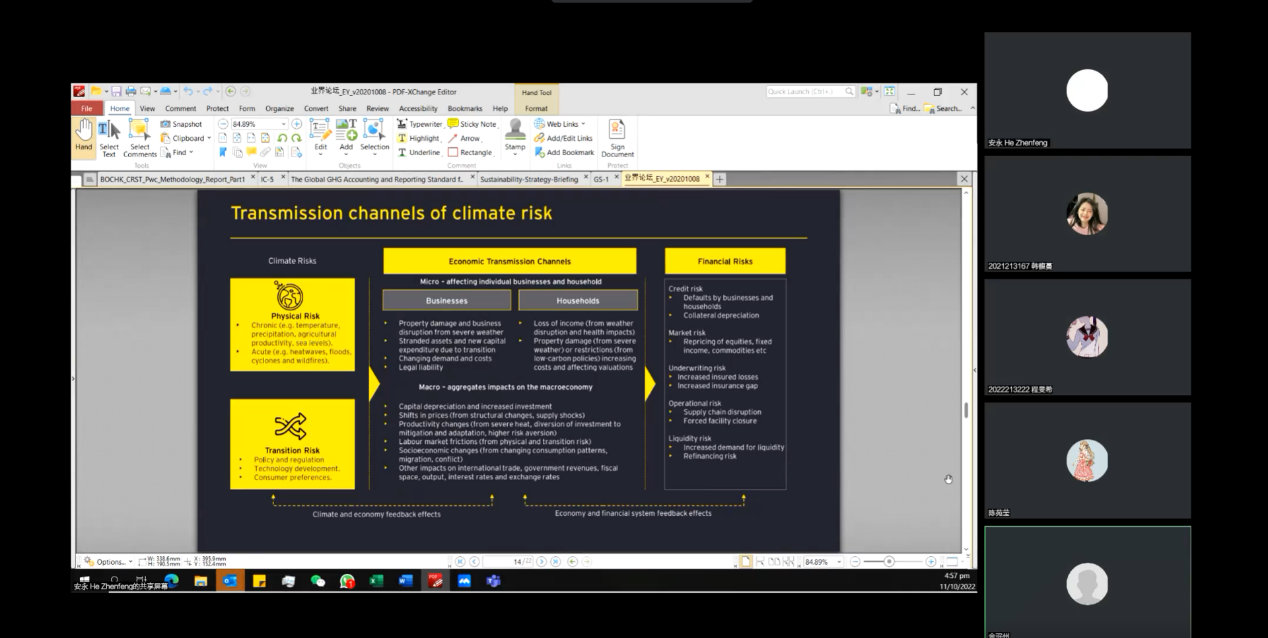
Afterwards, Teacher Jin introduced in detail the applicability and advantages and disadvantages of two different modeling methods, top-down and bottom-up. Taking climate risk as a case study, he focused on sharing the application of statistics and data science in scenarios, including data analysis, risk model development methods, and visualization display.
During the questioning session, the students actively and enthusiastically raised questions and had discussions with Professor Jinminzhou about their daily learning and life, as well as the work direction of statistical talents in consulting service companies. Professor Jinminzhou provided detailed answers to each question. Through this forum, students have gained a more comprehensive understanding and recognition of consulting service companies and the knowledge and skills required to engage in such work.
Contributors: Chen Yuhan, Dong Shi, Li Ruofan
Image provided by: Chao Jingwen