On November 28, 2023, our college invited alumni Professor Zheng Linlin to give a lecture at an industry forum on the theme of "New Trends and Practical Applications in Quantitative Investment".
Teacher Zheng Linlin, graduated with a Master's degree in Applied Statistics from Shanghai University of Finance and Economics, has previously worked at Huabao Securities and Zhongtai Securities. Currently, she serves as the head of the financial engineering team and chief analyst at Southwest Securities, engaged in research in the fields of financial engineering and FOF. While covering research on public equity funds, fixed income+, index funds, and private equity fund products, she closely tracks the forefront of quantitative stock selection and futures strategies in the market.
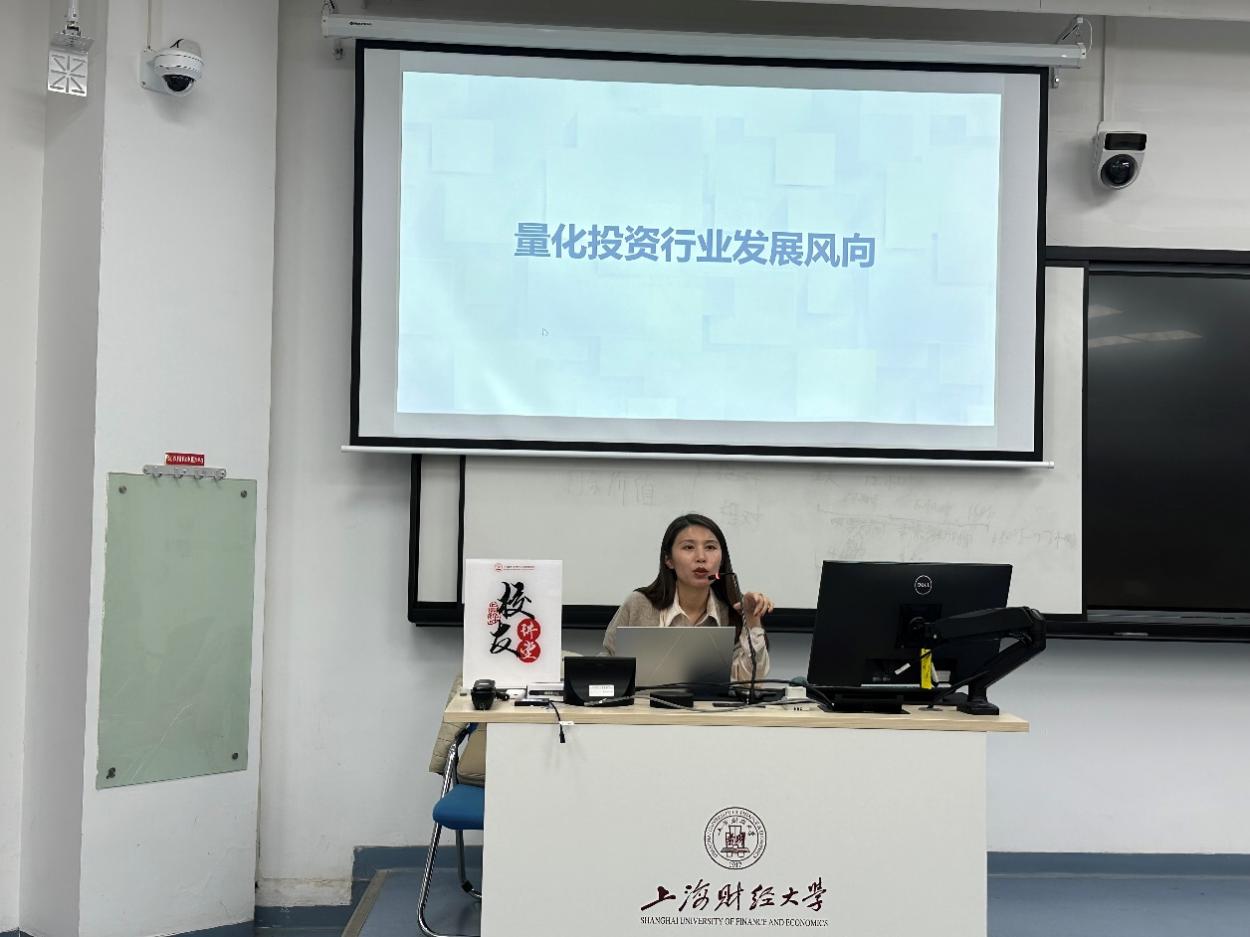
Teacher Zheng Linlin first started with the concept of quantitative investment, introducing the essential attributes of the combination of quantitative statistical analysis tools and investment concepts in quantitative investment. She pointed out that in practical industry work, quantitative and investment aspects can be recognized separately. She warned students that simply learning models and theories does not represent quantitative investment, but more importantly, investment logic and market data analysis. She suggested that students gradually exercise through contact and practice with the industry. Subsequently, Teacher Zheng introduced the advantages of quantitative investment over active investment in terms of discipline, systematicity, timeliness, accuracy, and diversification, enhancing students' comprehensive understanding of quantitative investment.
Teacher Zheng then introduced the current domestic quantitative product market, pointing out that in the past few years, the domestic quantitative market has developed rapidly, and private equity has performed particularly outstandingly. Teacher Zheng talked about the limitations of public fund platforms, which make it difficult to implement high-frequency strategies and volume price strategies. Private equity, benefiting from low fees and low regulation, can achieve richer strategy allocation and faster scale expansion. Therefore, quantitative private equity currently represents the forefront of development in China's quantitative field.
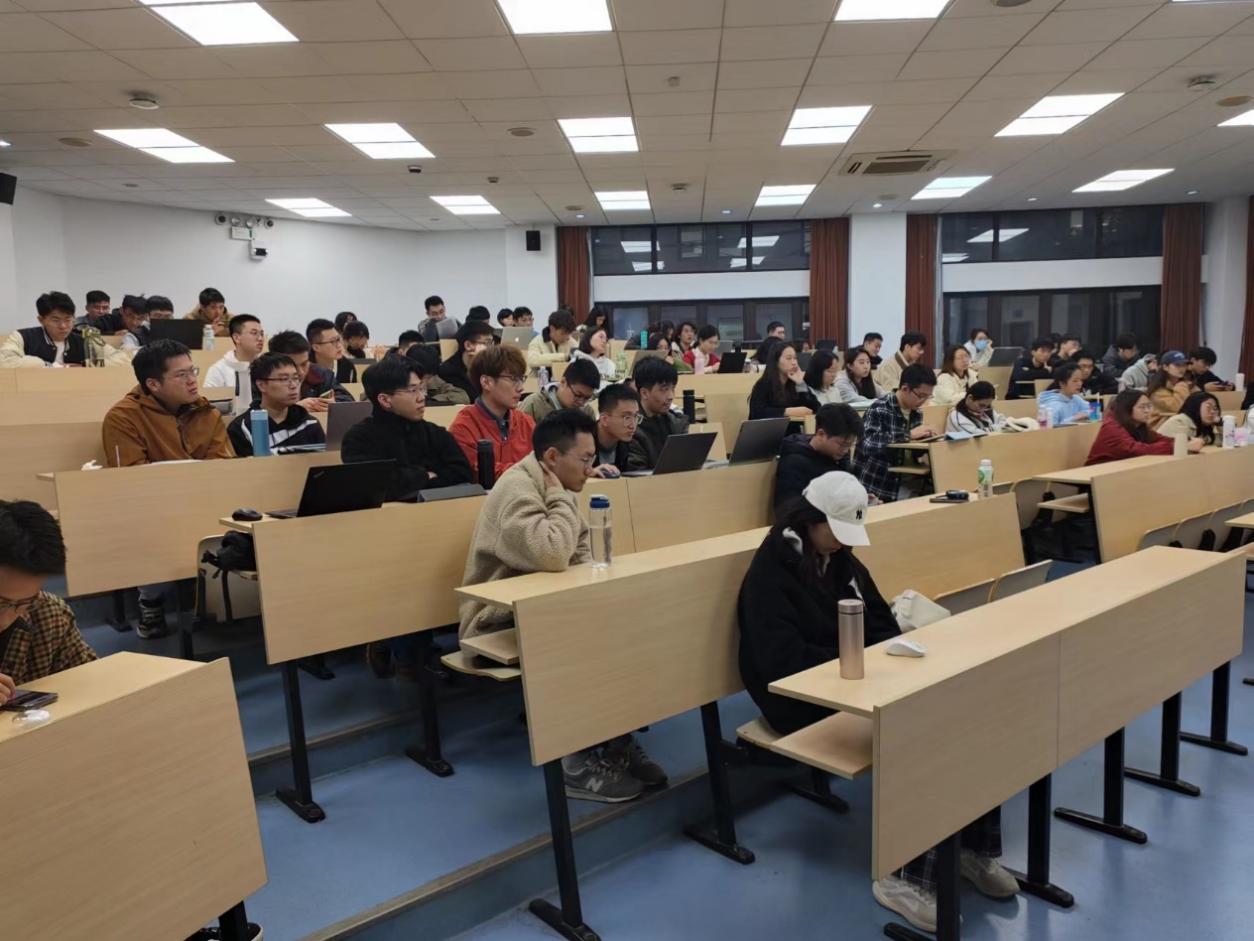
Afterwards, Teacher Zheng introduced the classification of mainstream quantitative investment application fields in the domestic market to the students, and gave examples of strategic applications in corresponding scenarios in the order of macro, meso, and micro. He analyzed the internal investment methodology and shared some practical cases of fund markets and quantitative schools within multiple public funds, deepening the students' understanding of the practical application scenarios of quantitative investment. Teacher Zheng suggests that before joining the field of quantification, students should understand the macroeconomic situation, analyze the internal logic and relationships of variables, not limited to computer models, and choose their own strengths and interests to join the quantification industry.
Finally, Teacher Zheng shared the follow-up situation of quantitative development in China, pointed out the problems existing in the current development of quantitative investment in China, and emphasized the broad prospects of quantitative investment development brought about by the booming development of artificial intelligence. Teacher Zheng talked about the potential development directions of quantitative investment in current cognition, including global asset investment services with absolute returns as the goal, demand driven financial product full process investment services, and artificial intelligence investment services with characteristic stock selection strategies as the trend. He also introduced in detail the job seeking departments in the quantitative industry and provided suggestions and assistance for students' depreciation planning.
During the questioning session, students actively raised their doubts about the specific work direction selection, internship situation, and application prospects of big models in the field of quantification. Teacher Zheng patiently provided answers, shared his experience and work experience in the field of quantification, and encouraged students to choose suitable tracks to actively join and continuously learn and develop their careers. Through this industry forum, students have gained a deeper understanding of quantitative investment and employment related content.
Contributors: Peng Xiaojian, Gu Meng, Wu Yaoyu
Image provided by: Wang Ziheng