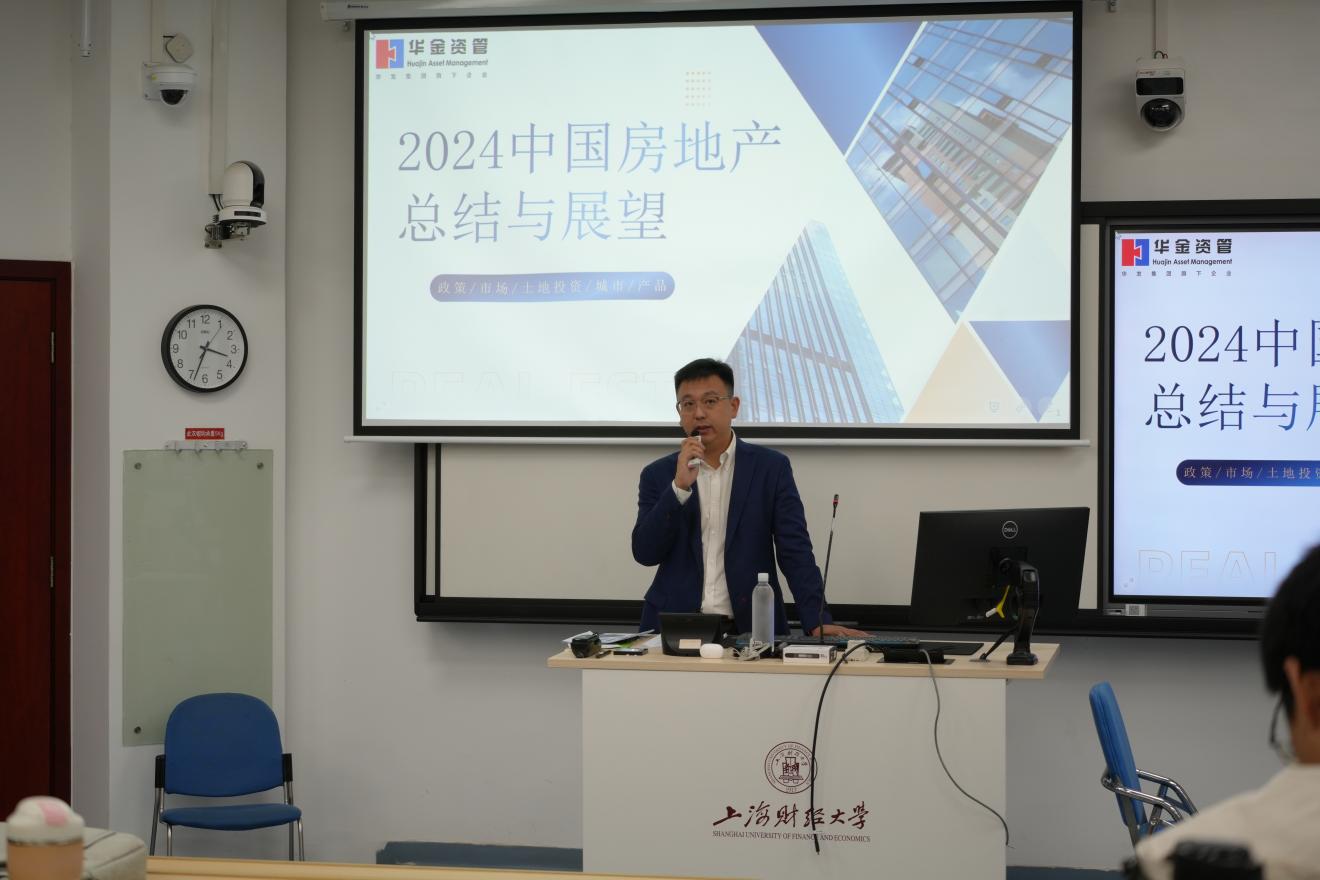
On the afternoon of October 15, 2024, our institute specially invited Mr. Chen Chen, the Managing Director of Huajin Asset Management, to give a lecture at an industry forum on the theme of "Review and Prospect of China's Real Estate Market in 2024".
Teacher Chen first summarized the overall situation of the real estate market in the first three quarters of 2024 for everyone. Overall, real estate sales in the first three quarters of 2024 have returned to the lowest level of the year. In terms of transaction volume, the transaction area of new houses in the key 100 cities in the first three quarters decreased by 32% year-on-year; Second hand houses performed better than new houses, with a year-on-year decrease of 2% in second-hand housing transactions in the first three quarters of the year in 30 key cities. Driven by the "price for quantity" policy optimization, the overall market in key cities has maintained a certain level of activity. Since June, the number of transactions in key cities has continued to increase year-on-year, and the overall transaction scale is relatively high. In terms of supply and demand, the approved listing area of the key 50 cities in the first three quarters decreased by 35% year-on-year, and the clearance cycle of sellable inventory continued to lengthen, with inventory depletion still under pressure. Afterwards, Teacher Chen summarized the overall situation of real estate policies in the first three quarters. It is pointed out that the May 17th policy in the middle of the year boosted market activity in June, but the policy effect weakened after the third quarter, and the market still faces significant adjustment pressure.
In addition, Teacher Chen talked about the development of the land sector under the influence of the downturn in the new housing market. The land transaction scale in the first three quarters of 2024 further decreased by 20% year-on-year, setting a new low for the national land transaction scale since 2010. The performance of cities at all levels is basically consistent, showing a trend of both quantity and price decline. Among them, the land transaction volume in first tier cities decreased by more than 30% in the first half of the year. On the urban side, Teacher Chen pointed out that the supply and demand in the third quarter decreased by 20% compared to the previous quarter, and both primary and secondary housing prices continued to decline and the decline widened. The third and fourth tier cities along the southeast coast accelerated their correction. The inventory turnover cycle of new houses has risen to a 27 month high.
Afterwards, in terms of product development, Teacher Chen pointed out that the fourth generation of residential buildings is accelerating. In the first three quarters of 2024, the real estate market maintained an overall stable trend under the influence of favorable policies in the early stage. The demand for "good houses" in the market is increasing day by day, and real estate companies are actively working on the product side to attract homebuyers and meet the long-term demand for residential upgrading in the market by providing higher quality products.
Finally, Teacher Chen proposed a trend outlook for the Chinese real estate market from the perspectives of policies, markets, land investment, and products. The policy will be further implemented in the fourth quarter, and the central government will open up space in reducing mortgage interest rates and adjusting taxes and fees; The four restrictions policy in first tier cities at the local level is expected to be further optimized, while demand side policies in second - and third tier cities will mainly focus on incentive aspects such as credit policies, trade in policies, and housing subsidy policies, and promote supply side policy adjustments with a focus on high-quality residential construction and pilot sales of existing houses. The market is expected to see marginal improvement, and currently "price for quantity" is still the mainstream in the market. Interest rate cuts can alleviate the phenomenon of rent to sales ratio inversion, but there is still downward pressure on housing prices in the short term. In terms of land investment, considering the improvement of supply side quality combined with multiple favorable policies from the central government, the popularity of some high-quality land may increase to a certain extent. In terms of products, the fourth generation of residential buildings is expected to become a breakthrough in the iteration of residential products in the future. At the same time, the strong demand for luxury residential buildings will continue to drive the continuous iteration of high-end residential products.

During the questioning session, students raised questions about whether to choose a second-hand house in the city or a new house in the suburbs when buying a house, how intermediaries recommend buying a house, how to judge the development trend of the real estate market in real life to make decisions, and whether to rent or sell a house. Teacher Chen provided detailed answers and examples from a professional perspective, and gave corresponding suggestions. Through this industry forum, students have benefited greatly and gained a deeper and more comprehensive understanding of the development of China's real estate industry.
Contributors: Teacher's Message, Shen Ruoyan, Yang Xinyi
Image provided by: Wu Zhangxuan