On the afternoon of October 29, 2024, our institute invited Dr. Zhu Bing, the research and development leader of quantum and artificial intelligence at HSBC Laboratory, to hold an industry forum with the theme of "Brief Introduction to the Development of Generative Artificial Intelligence in China's Banking Industry", which attracted many teachers and students to participate.
Dr. Zhu first introduced the relationship between the research of Nobel laureates and artificial intelligence, making us realize that artificial intelligence has already and will continue to change the world. He also introduced us to the development process of artificial intelligence since the 1950s. Despite experiencing several "AI winters", due to technological progress, especially the breakthrough in deep learning after 2012, artificial intelligence has made significant progress in fields such as image recognition and natural language processing. Dr. Zhu, from the perspective of a bank, simulated some small scenarios and proposed the potential of AI in bank data synthesis, which can help customize services and improve user experience. This is a very meaningful thing.
Then, Dr. Zhu discussed the competition and cooperation between China and the United States in the field of artificial intelligence, with a particular emphasis on the development of large-scale models, patent and paper output, market participating companies, and data advantages. Although the United States has more resources and achievements in big model and AI companies, China has also demonstrated strong competitiveness, especially in the field of big model startups. Dr. Zhu then focused on the situation in China and analyzed the overall large model through three charts, drawing the following three conclusions: in terms of quantity, the number of large models continues to rise; In terms of model categories, the proportion of generic models has decreased, while the proportion of industry-specific models has increased; In terms of geography, big cities such as Beijing and Shanghai have a relatively large proportion. At the same time, Dr. Zhu introduced us to the three stages of the development of large-scale models, which can be divided into three stages: preparation, response, and reform. During the preparation phase, Fudan University was the first to release the first large-scale model in China, followed by Peking University and other companies joining in. In the response phase, large companies began to participate in competitions and invest resources in the research and development of large models. During the reform phase, the release of large models became common, and top companies continued to lead the market by accumulating computing power and talent advantages. The entire process reflects China's rapid development and fierce competition in the field of large models.
Next, Dr. Zhu introduced us to some application scenarios of generative artificial intelligence in banks. Generative artificial intelligence can play a role in intelligent customer service, personalized marketing, investment advice, and improving service efficiency in the banking industry. Currently, banks of all sizes are experimenting with various large-scale models to varying degrees.
Next, Dr. Zhu introduced us to the regulatory aspects of large models. The large model ecosystem in our country is relatively closed, with regulatory requirements mainly for data input and algorithm aspects. In April last year, the State Internet Information Office issued the Administrative Measures for Generative AI Services (Draft for Comments), which finally clearly stipulates that generative AI providers should take full responsibility for the services they provide.
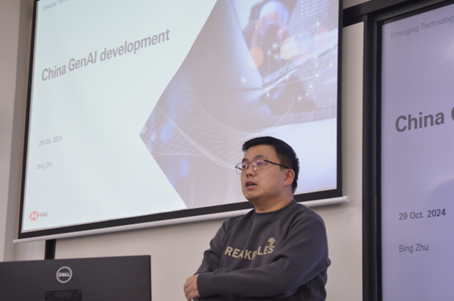
Afterwards, Dr. Zhu discussed the development direction of large models by combining the development of artificial intelligence with the practical aspects of banking, emphasizing the importance of multimodal processing, including the ability to process text, images, audio, and tabular data. At the same time, the continuous expansion of model parameter scale from billions to trillions, as well as the enormous technical challenges faced in training these large models, such as the increasing demand for computing resources, were mentioned. In addition, the potential application of large models in the field of financial services, especially the improvement of real-time interactivity, was also discussed. From the perspective of banks, Dr. Zhu discussed how banks can use technology and digital transformation to improve economic service efficiency, and emphasized the importance of risk control in this process. It is proposed that banks should adapt to the technological enthusiasm of Internet companies, while maintaining their focus on traditional financial services. Explored the risks brought by big model technology, including data bias, model opacity, reliability issues, and privacy protection, emphasizing the challenges that need to be addressed when using new technologies.
Finally, Dr. Zhu summarized to us some of the risks associated with artificial intelligence, including bias, interpretability, output dependency, confidentiality and privacy principles, illusion issues, intellectual property protection and infringement, malicious use, etc. He emphasized to us that having a clear risk awareness is the first step to becoming a qualified financial professional.
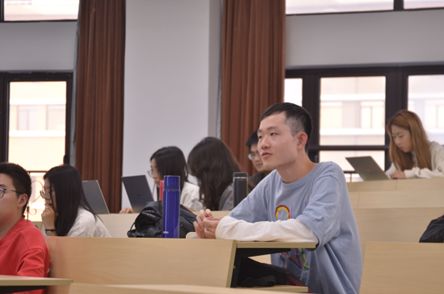
During the questioning session, students actively participated in in-depth discussions on the role of prompt words in large models, how banks can invest in high training costs for large models, and how to better prevent illusion problems in large models. Dr. Zhu provided detailed answers to each of his classmates' questions based on his own research and experience. Through this industry forum, students have gained a deeper understanding of generative artificial intelligence and its applications in the banking industry.
Author: Guan Yiheng
Image provided by: Zheng Linkai