In the afternoon of March 18, 2025, the School of Statistics and Data Science of Shanghai University of Finance and Economics successfully held a special forum on the "Application of generative AI in the Internet e-commerce industry" in Classroom Ti 6, Wudong Road Campus. Gao Ping, Deputy Secretary General of Shanghai E-Commerce Industry Association and senior expert of Fudan University Smart City Research Center, was specially invited as the keynote speaker.
In the theme introduction section, Mr. Gao started with a dynamic demonstration of the "Intelligent Pricing Game Model" and pointed out that AIGC technology is driving the evolution of the e-commerce industry from "traffic operation" to "intelligent creation". He emphasized that the current industry is facing three challenges: insufficient supply chain resilience, surge in personalized demand, and complex global operations, and generative artificial intelligence will become the key to breaking through.
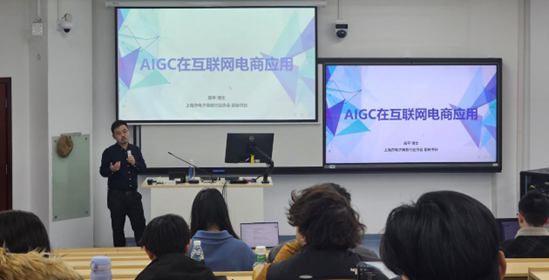
In the wave of digital transformation, generative artificial intelligence (AIGC) is reshaping the ecological pattern of Internet e-commerce with subversive force. At the beginning of the lecture, Mr. Gao, with his profound professional knowledge and rich industry experience, introduced the classification methods of the e-commerce industry in a clear and concise manner. He believed that e-commerce can be mainly divided into two categories: consumer e-commerce and industrial e-commerce. Among them, the typical platforms of consumer e-commerce include Tmall, JD, Tiktok e-commerce, Xiaohongshu, etc; Typical platforms for industrial e-commerce include MRO, Shanghai Steel Union (bulk commodities), and Yunhan Xincheng (electronic components).
In addition, Mr. Gao vividly explained the utilization methods of AIGC in different types of e-commerce through several case studies. In the field of consumer e-commerce, generative artificial intelligence is mainly applied to tasks such as content production, advertising placement, and intelligent shopping guidance. For example, a certain consumer e-commerce platform utilizes generative artificial intelligence technology to quickly generate a large number of exquisite product display images and attractive product copy based on different seasons, festivals, and trends, greatly shortening the content production cycle, reducing labor costs, and improving the accuracy and effectiveness of advertising placement. In terms of industrial e-commerce, generative artificial intelligence focuses on building internal knowledge bases and industry knowledge bases within enterprises. Taking Zhenkun's behavior as an example, through AIGC technology, they are able to integrate massive industry data and professional knowledge, provide customers with more accurate procurement advice and solutions, and enhance the service quality and competitiveness of enterprises.
Afterwards, Mr. Gao analyzed in detail the deep application of AIGC technology in the core scenarios of e-commerce. In terms of intelligent content production, AIGC can quickly generate product display images and product copy, significantly shortening the content production cycle and reducing labor costs; In the field of personalized recommendation, the AIGC algorithm based on deep learning can accurately perceive potential consumer needs, achieve "thousand people, thousand faces" product push, and effectively improve purchase conversion rates; The virtual shopping assistant utilizes AIGC technology to answer questions and provide thoughtful services to consumers at any time, significantly optimizing the shopping experience; In cross language marketing, AIGC can efficiently complete multilingual content creation and translation, helping e-commerce companies break down language barriers and explore global markets.
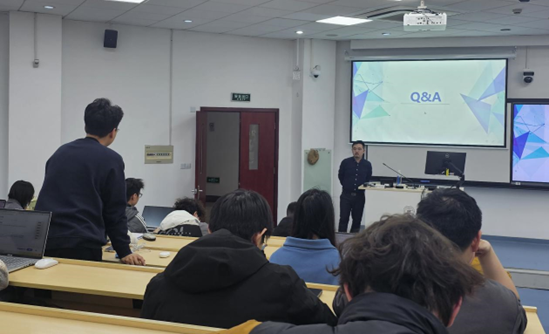
The questioning session was full of excitement, and the atmosphere on site was lively. Students engaged in in-depth discussions on the boundaries of technology. Regarding the "AI replacement anxiety", Mr. Gao emphasized that "algorithms can generate tens of thousands of design drawings, but the aesthetic judgment of the chief aesthetic officer cannot be replaced; The system can simulate thousands of service scripts, but empathy is the soul of the service industry. For data security issues, he suggested that enterprises establish a three-level protection system of "data sandbox permission isolation content traceability". Students actively asked questions about the data security, technical cost, and talent demand of AIGC technology in e-commerce applications, and Mr. Gao patiently answered them one by one. He pointed out that although AIGC has brought unprecedented opportunities to the e-commerce industry, there are still many challenges to overcome in practical applications. Enterprises need to actively embrace changes, strengthen technological innovation and talent cultivation.
This forum presents the three-dimensional reshaping power of AIGC technology on the e-commerce industry through theoretical deduction, case analysis, and scenario demonstration. Representatives of enterprises attending the conference said that they would accelerate the transformation of layout intelligence. At the same time, the college announced the launch of the construction plan of "e-commerce AI innovation laboratory", which continued to promote the deep integration of industry, university and research. It provided a valuable learning and exchange opportunity for students, deepened everyone's understanding of the application of generative human intelligence in the Internet e-commerce industry, and guided the students to move forward.
Contributors: Fu Quanlun, Zhang Xiangyi, Zhao Haojie
Image provided by: Zheng Biyun