On the afternoon of September 22, 2025, the School of Statistics and Data Science at Shanghai University of Finance and Economics successfully held a special forum on "Quantitative Trading of Private Equity Funds and Investment Strategies of Convertible Bonds" in Room Ti 6 of Wudong Road Campus. Wang Zhongyang, the fund manager of Shanghai Hanhong Private Equity Fund Management Co., Ltd., was specially invited as the keynote speaker.
At the beginning of the presentation, Mr. Wang Zhongyang introduced the industry to his classmates in a down-to-earth manner. He stated that the content of this session mainly revolves around three keywords: private equity funds, quantitative trading, and convertible bonds. The three major characteristics of private equity funds, including non-public fundraising, high risk return level, and flexible investment strategies, make them important tools for professional investors to allocate assets.
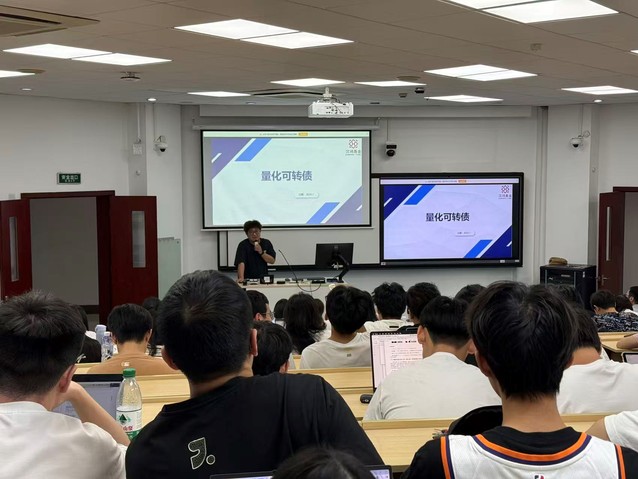
Mr. Wang Zhongyang further elaborated on the characteristics and practical requirements of quantitative trading strategies based on his own understanding. He pointed out that quantitative strategies are based on predetermined rules and mathematical models as the decision-making basis, avoiding the interference of human emotional fluctuations on operations; Simultaneously, quantitative strategies have efficient execution capabilities and can complete complex trading instructions in milliseconds; By utilizing real-time monitoring of multidimensional risk parameters, more precise risk control can also be achieved. Mr. Wang Zhongyang also mentioned the potential risks of quantitative trading, such as the possibility of overfitting in the model due to changes in the market environment, or the failure of underlying logic leading to lower than expected strategic returns. He further supplemented the skills that students need to master for engaging in quantitative trading. In addition to core programming languages such as Python and C++, they also need to be proficient in professional abilities such as database management, time series analysis, probability statistics, and financial data analysis, in order to prepare for building effective quantitative models.
As the core topic of this forum, convertible bonds, Mr. Wang Zhongyang provided a clear and concise analysis. He first explained the definition of convertible bonds, which are a hybrid security between bonds and stocks, with fixed face interest and the right to convert into stocks. The domestic convertible bond market began in the 1990s and developed rapidly since 2017. In August 2022, regulators implemented new regulations on convertible bonds, mainly including limiting the price range of convertible bonds, increasing convertible bond commissions, and raising the threshold for individual investors.
Mr. Wang Zhongyang also focused on analyzing the three core terms of convertible bonds: conversion, forced redemption, and downgrading. Among them, the conversion clause grants holders the right to convert bonds into stocks at the agreed price, which is a direct manifestation of the stock nature of convertible bonds; The mandatory redemption clause allows listed companies to forcibly redeem bonds at face value plus interest when the stock price continues to exceed 130% of the conversion price, which is equivalent to a "passive profit taking" mechanism; The revised clause specifies that when the stock price continues to be below 80% of the conversion price, the company can increase the number of shares converted by convertible bond holders by lowering the conversion price, in order to hedge against the risk of stock price decline. In addition, Mr. Wang Zhongyang presented data showing that the cumulative returns of the CSI Convertible Bond Index from 2017 to 2025 far exceeded those of major stock indexes such as the Shanghai Composite Index and the CSI 300. He believes that the long-term performance of the convertible bond index is significantly better than that of major stock indexes because the compulsory redemption mechanism can lock in and include upward returns, the downward revision clause can effectively buffer downward risks, and the convertible bond issuance review standards are strict. Only about 27% of listed companies can meet the issuance conditions, thus ensuring the quality of the underlying assets from the source.
In the field of convertible bond trading, companies have systematic strategies and methods for conducting convertible bond business. Mr. Wang Zhongyang mentioned that the company has independently built a multi factor model using the T0 model to conduct a tiered scoring evaluation of convertible bonds. Given the recent high popularity of the convertible bond market, this approach can more accurately capture the potential value of convertible bonds. At the same time, closely monitor the premium rate of convertible bonds, which usually shows a positive premium state with an average premium rate level of around 10%, and use the stock price of the underlying stock as an important anchor point. For example, when the premium rate is at 10%, if the underlying stock rises but the premium rate lags behind and falls to the threshold of 5%, the convertible bond will be bought in advance and then sold at the theoretical price. In addition, stock index options strategy will be used as an auxiliary tool to achieve the goal of achieving an annualized performance of 20%.
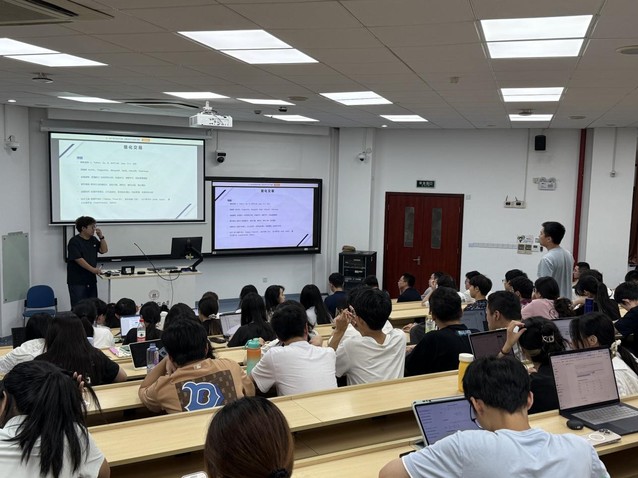
Entering the interactive student questioning session, the atmosphere on site was very lively. A student focused on quantitative transformation and asked about the preferences of C language and Python in strategy development if they switch to quantitative trading, as well as the significance of fundamental analysis, although it currently does not involve macro level analysis. Some students are also concerned about the opportunities for individual investors to participate in convertible bond trading. Mr. Wang Zhongyang believes that the opportunities for individual investors to buy new bonds when they are listed are relatively limited, and it is difficult for individuals to buy through their accounts. In the case of a single board, whether convertible bonds can be traded depends on the specific performance of the underlying stocks.
Contributors: Zhao Xiaojun, Zhang Yining, Zhao Huiwen
Image provided by: Duan Wenfei