
Name: Zhang Zhi Heng
Title: Tenure-track Assistant Professor
Research Direction: Experimental Design, Observational Research, Online Learning, Machine Learning and Applications
Courses Taught: Probability Theory (Undergraduate), Data Analysis and Statistical Modeling (Graduate)
E - mail: zhangzhiheng@mail.shufe.edu.cn
Phone: 18811613726
Research Project
Serial Number | Project Name | Project Number | Project Source | Start and End Time | Project funding |
1 | Unified multi-treatment LTV causal model | 2025 CCF-DiDi Gaia Scholar Research Fund (Co-Leader) | 2025.9-2026.9 | ||
Research Area
In order to understand and construct the core theoretical structure of causal learning systems, the laboratory's long-term goals can be summarized into the following three fundamental questions: (i) In observational studies: How to systematically characterize the transmission mechanism between "model assumptions—observational data—identification boundaries," thereby revealing the fundamental impact of various causal assumptions on identifiability? (ii) In experimental design and inference: How to quantitatively describe the performance limits between "application scenario attributes—experimental design and algorithm structure—statistical efficiency," and based on this, develop design and inference frameworks with (near) optimal properties? (iii) In online learning and decision-making: How to mathematically unify the optimization objectives of different fields such as machine learning, economic management, and statistical inference, revealing their fundamental compatibility and optimal attainable boundaries?
To answer the above questions, the overall research approach of the laboratory follows a layered progression from theory to methodology and from methodology to practice: (i) starting from violations of fundamental assumptions, we construct a more inclusive framework for causal inference, such as exploring violations of assumptions like unconfoundedness, overlap, and SUTVA; (ii) integrating these foundational structures with modern statistical and machine learning methods to develop more efficient, stable, and scalable identification and estimation techniques, such as optimal transport, proxy variable and negative control methods, coadaptive prediction, minimax optimization, and online learning; (iii) further extending the theory and methods to task settings with real-world constraints, such as complex input/output structures, few-shot learning, and dynamic/missing network structures; (iv) ultimately forming a causal inference system that can effectively radiate to real-world scenarios, serving social network analysis, game-theoretic environments, optimization decisions, and implemented in recommendation systems, dispatch mechanisms, market intervention strategies, and large model behavior modeling.
Among them: (i) focusing on more relaxed structural assumptions at the input level, (ii) concentrating on precise and efficient recognition-estimation mechanisms at the algorithmic level, (iii)-(iv) primarily targeting complex and realistic decision-making and inference tasks at the output level. To gradually achieve this, the laboratory is currently focusing its research on the following three specific directions:
(i) Online experiment design and inference under a network structure.
(ii) Optimal Transport (OT) and Geometric Structure in Causal Inference.
(iii) Causal inference methodologies oriented toward industrial reality constraints (e.g., RCT & OBS, pre & opt, structural data types).
Educational Background
2020.9-2025.6 Tsinghua University Interdisciplinary Information Research Institute PhD
Work Experience
2025.9-Present Shanghai University of Finance and Economics School of Statistics and Data Science Assistant Professor
Research Achievements
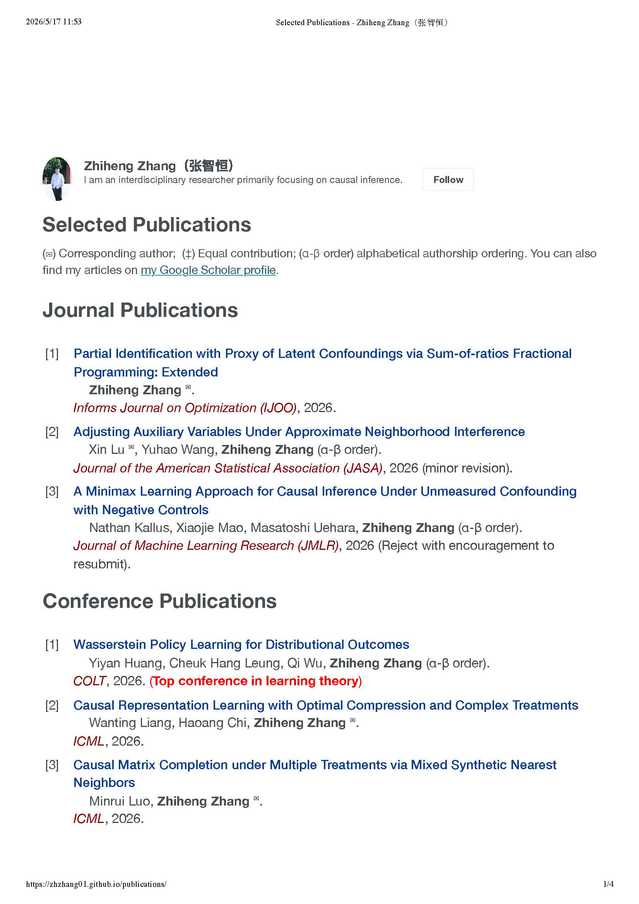
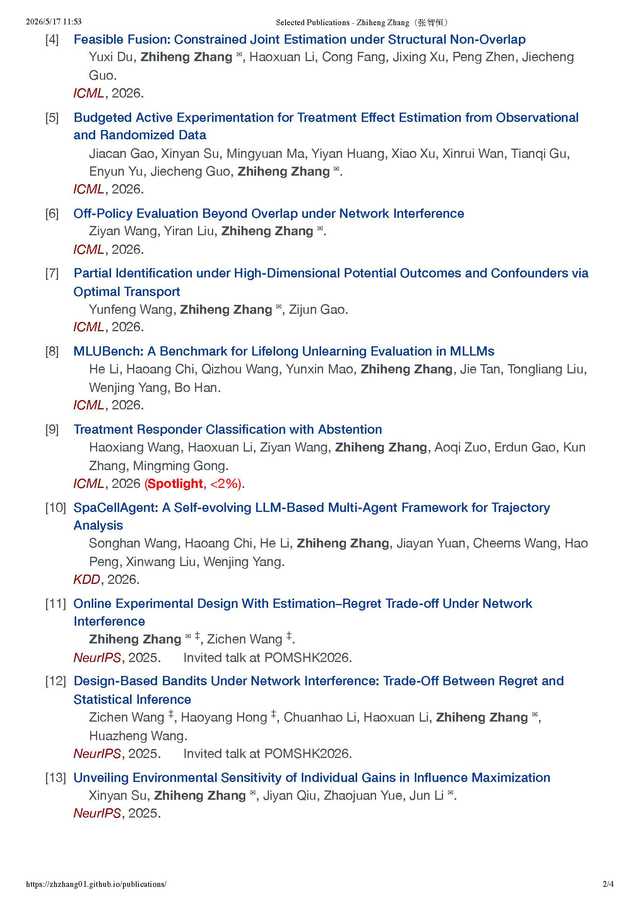
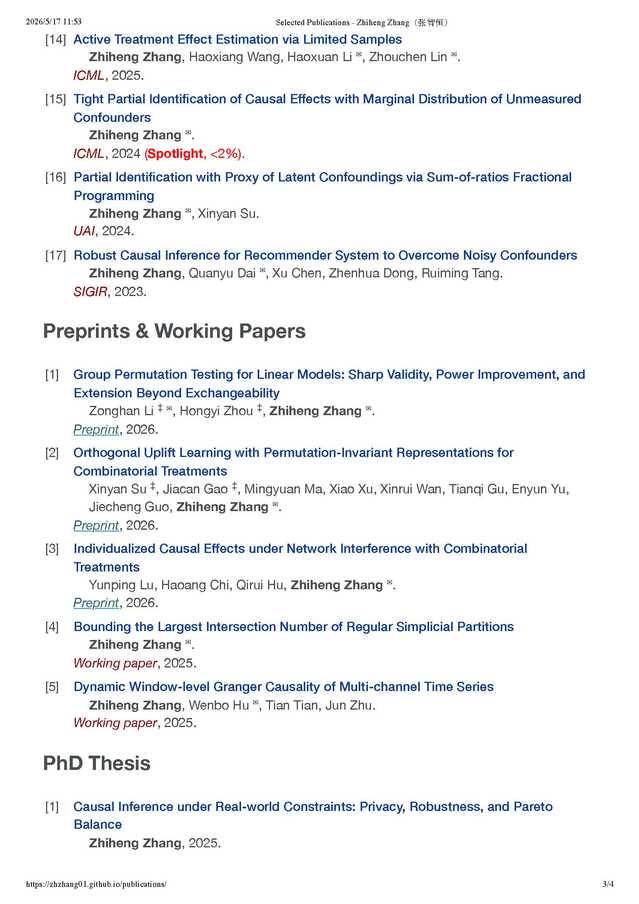
See the homepage:https://zhzhang01.github.io/
Rewards, Honors
ICML2024 Spotlight
Social Work
AAAI AICT track area chair